


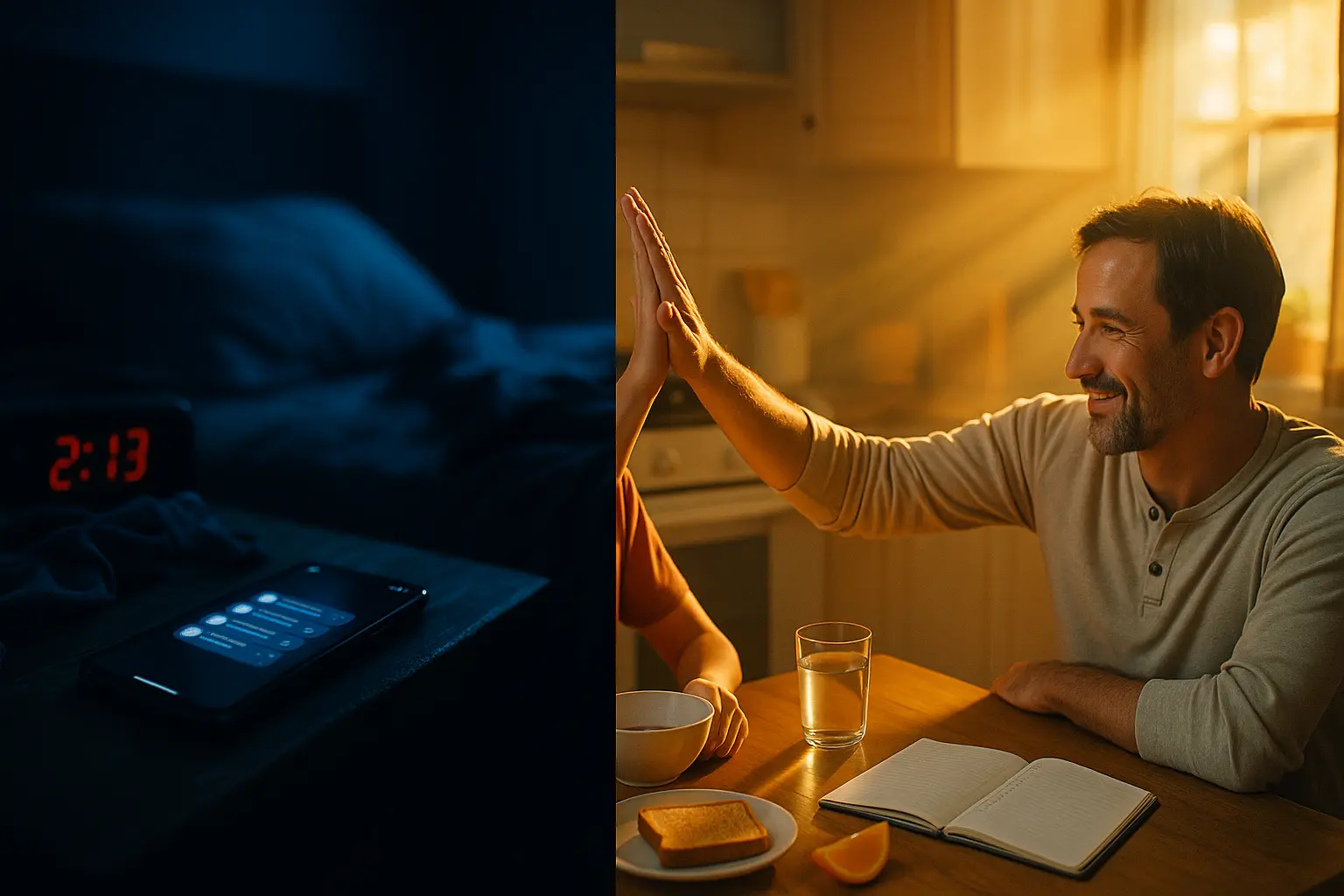
When success keeps you awake
Insomnia, anxiety, and expectations (of parents and children) at the start of the school year—and how to start changing things in 10 days

The problem is not wanting the best, but how we pursue it. The combination of too little sleep + rigid expectations + constant comparison fuels insomnia and anxiety. The good news: there are concrete tools—using light, conversation, breathing and scheduling—that turn down the threat system and open up focus.
WOW #1 · Getting ≥8 h of sleep among adolescents is associated with a lower prevalence of all indicators of poor mental health and lower suicide risk (CDC 2024). The problem: most do not get that much on weekdays.
WOW #2 · Sleep societies recommend school start times ≥08:30 in secondary school. It is not ideology: it is circadian physiology and mental health (AASM).
WOW #3 · From 1989 to 2016, perfectionism increased among college students: self-imposed demands, perceived parental expectations, and criticism rose. More perfectionism = more depression/anxiety (APA).
The triangle that keeps us awake (and how it feeds itself)
1) Insufficient sleep
More emotional reactivity and poorer self-regulation the next day. Less sleep = more depressive symptoms and suicidal ideation in adolescents.
2) Rigid expectations
This fuels evaluative perfectionism (“nothing is enough”), rumination, and performance-related insomnia. The style of expectations matters.
3) Comparison 24/7
Feeling “behind in life,” anxiety, and procrastination. It becomes harder to get started… and to sleep.
Clinical translation: it is not a “lack of willpower”; it is a lack of structure that supports attention and rest.
7 family (and personal) agreements that make a real difference
1) Light in the morning, warm lighting at night
15–20 min of outdoor light within the first hour after waking: shifts the clock earlier and improves alertness. At nightfall, dim the lights and make them “warmer”. For delayed sleep phase, consider timed melatonin (selected cases) + a block of morning light.
2) Sleep is nonnegotiable (and so is the schedule)
Between weekdays and weekends, shift your wake-up time by < 90 min . If your school starts early, double down on morning light and routine. AASM supports start times ≥08:30 for health, attention, and mood.
3) CBT‑I before pills (adults)
CBT‑I is a first-line treatment for chronic insomnia, with lasting benefits. Digital versions improve access.
4) Breathing to turn down the alarm system (5 minutes)
Cyclic sighing (a nasal inhale + a small extra inhale + a slow exhale through the mouth) improved mood compared with brief mindfulness in an RCT. Use it before bed or before difficult conversations.
5) Expectations: from “you should” to a “measurable plan”
Replace identity-based goals (“be the best”) with concrete habits: three 25′ blocks + a break, for example. At home, two dinners without talking about grades each week; we talk about efforts and progress.
6) Schedule with your body in mind (not guilt)
- Protected blocks (25–45′) + breaks.
- Body‑doubling (working silently alongside someone) to get started.
- The 2-minute rule: if it takes <2′, do it now; otherwise, put it on the list with a realistic date.
7) An “end-of-day” routine that really switches off the mind
60–90 min without screens, a warm shower, tomorrow’s notes on paper (unloading rumination). If you are hungry: plain yogurt + nuts or herbal tea.
A conversation guide for parents (3 questions)
- What went well for you today… even if it was something small?
- What would you put in tomorrow’s plan to make it easier to get started?
- What do you expect of yourself? And what do you expect of us? (negotiate support and boundaries)
Clinical note: parental factors (involvement, warmth, criticism) remain relevant in adolescent anxiety/depression: adjusting how we provide support is part of treatment.
A 10-day plan to notice a difference (adults and families)
Goal: fall asleep earlier, reduce presleep anxiety, and get started on tasks more easily.
Day 1 · Morning light
15–20′ after leaving home (before looking at your phone). Record the time you fall asleep.
Day 2 · Dinner and screens
A simple dinner (protein + vegetables + whole grains). Screens off 60–90′ before bed.
Day 3 · Cyclic breathing
5′ at nightfall (inhale + small extra inhale · slow exhale).
Day 4 · Conversation
Two dinners without discussing grades/goals. Share efforts and small victories.
Day 5 · Work blocks with your body in mind
25–45′ + a break; body‑doubling to get started.
Day 6 · A fixed schedule
Set a fixed wake-up time (including weekends).
Day 7 · CBT‑I
If insomnia persists: request CBT‑I (in person or digital).
Day 8 · Warm lighting at nightfall
Lower light intensity and color temperature at dusk (circadian alignment = shorter latency).
Day 9 · Expectations
Replace 2 “you should” statements with 2 measurable habits.
Day 10 · Review
Falling asleep earlier? Less rumination? More minutes on task? Keep what worked.
Quick questions (FAQ)
“My child sleeps 6–7 hours and says that is enough.”
The evidence is clear: in secondary school, getting ≥8 h of sleep is associated with better mental health and lower risk of suicide-related indicators. It is not a matter of preference: it is about protecting the brain.
“Is sleep medication essential?”
Not necessarily. For chronic insomnia, CBT‑I is first-line treatment; medications can act as a bridge in selected cases.
“Can something that takes 5 minutes help with nighttime anxiety?”
Yes: cyclic breathing for 5 minutes showed better results than brief mindfulness for positive affect and autonomic calm.
Key sources: CDC 2024 (≥8 h of sleep and adolescent mental health); AASM (start times ≥08:30; CBT‑I as first-line treatment); APA / Psychological Bulletin (rising perfectionism); reviews of parenting and emotional risk; trials of light/melatonin and circadian phase; an RCT of Cyclic sighing (Cell).
Educational information; it does not replace an individual medical assessment. If there is an acute risk, go to emergency services.


