


⚡ ARTICLE 6/6 — Psychiatric medications of the future
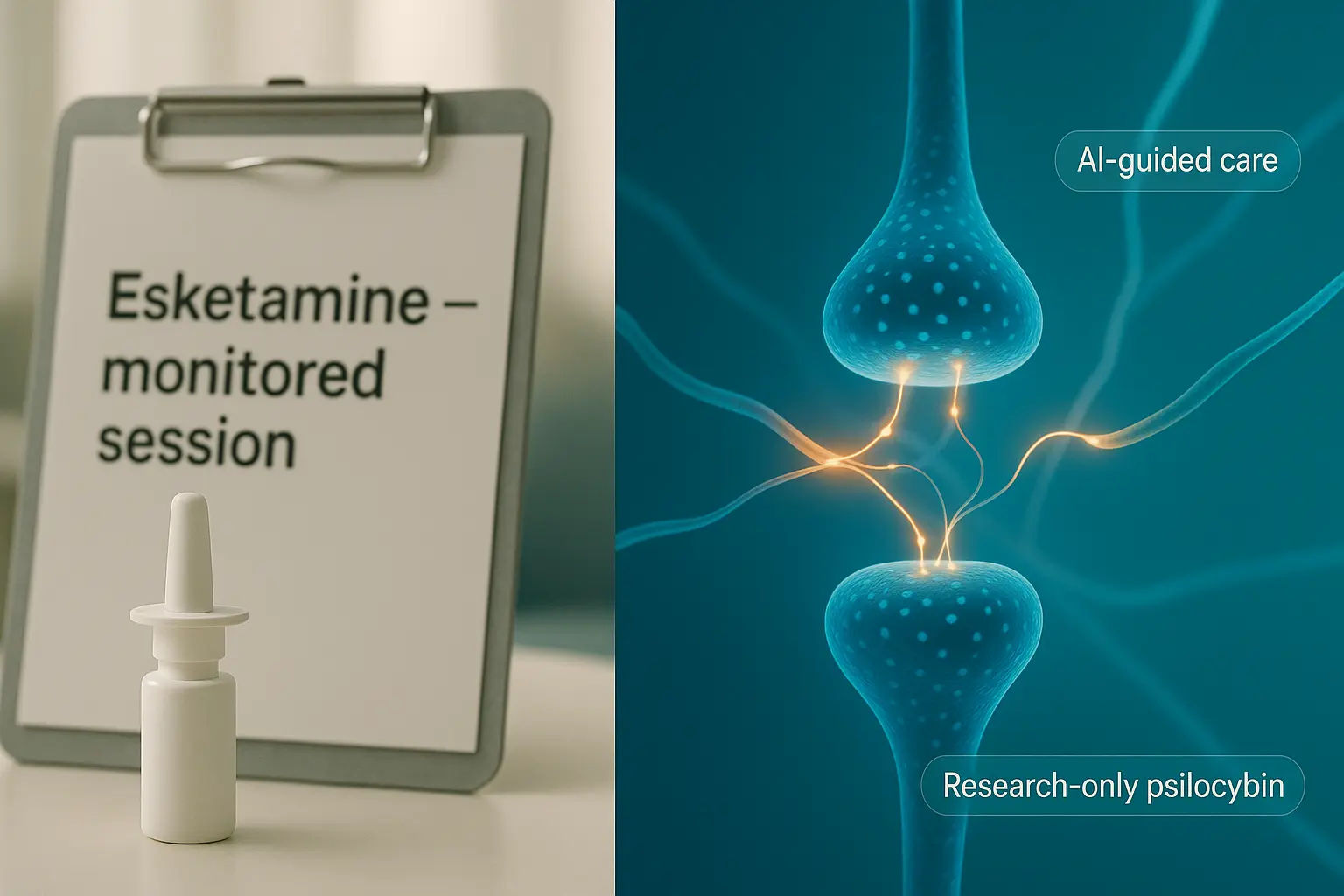
In 30 seconds: Three waves converge in 2025: glutamate (fast-acting ketamine/esketamine), AI (response prediction), and the revival of herbal medicine with better methods. The useful question is not whether they “work,” but for whom, how and under what conditions of legality and safety. In Spain, esketamine is approved for TRD; psilocybin remains under investigation (AEMPS trials).
The essentials (without jargon)
- Fast, but not magic: ketamine/esketamine open a window of plasticity; it needs to be consolidated with habits and psychotherapy.
- AI = a compass, not a pilot: it will help prioritize treatments, but the decision will remain clinical and based on discussion.
- Plants with a method: adjunctive options in selected cases and with standardized extracts; they do not replace first-line treatments when these are indicated.
- Legal status in Spain: esketamine is approved with protocols; psilocybin only in clinical trials; avoid unregulated channels.
1) Psilocybin: clinical promise (still under investigation in Spain)
What the evidence suggests
Significant short-term results in treatment-resistant depression with preparation and psychotherapeutic support; frequent but manageable adverse events (nausea, headache, transient anxiety). Longer and comparative trials are underway.
What it does not demonstrate
There is no robust evidence of sustained superiority over standard antidepressants; head-to-head trials have shown nuanced results (e.g., no superiority over escitalopram at 6 weeks on several outcomes).
Spain 2025
Not approved as a medication. Clinical access: only in AEMPS-authorized trials (REec). Clearly distinguish research from clinical care.
2) Ketamine and esketamine: fast, protocol-based, and followed up
- Rapid-onset efficacy in some patients with TRD; the challenge is maintaining the response with plans for optimization/maintenance.
- EU/Spanish regulation: intranasal esketamine is authorized for TRD (with an SSRI/SNRI). In the EU, also for the rapid reduction of symptoms in a psychiatric emergency, under strict conditions.
- Safety: possible dissociation, drowsiness, vertigo, and transient blood pressure elevation → clinical observation after dosing and discharge criteria; advice to avoid driving after the session.
- New in 2024: early signals with extended-release oral ketamine (phase 2)—feasibility of remote use awaits replication and regulatory assessment.
3) AI in psychiatry: a useful compass, with caution
What it already offers
Models integrating EEG and clinical data are beginning to predict response better than chance; they help stratify and generate hypotheses.
What is missing
Validations that are prospective, replication, and standards before routine use. AI guides; clinical decisions remain human.
A practical bridge
Affordable biomarkers (e.g., hsCRP) may identify inflammatory phenotypes with poorer responses to standard treatment and candidates for adjunctive anti-inflammatory treatment.
4) Plants and nutraceuticals: thoughtful adjuncts
- Ashwagandha: a small-to-moderate reduction in stress/anxiety in RCTs; standardized extracts and a review of interactions are essential.
- Saffron: antidepressant benefit in mild depression versus placebo; results comparable to SSRIs in some RCTs; not a substitute for 1st-line treatment in moderate-to-severe depression.
- Rhodiola: less effective than sertraline but better tolerated in mild-to-moderate depression; an option when tolerability is the priority.
- N-acetylcysteine (NAC): a signal of improvement as an adjunct (especially in bipolar disorder), with heterogeneity; monitor comorbidities and interactions.
The integrative golden rule: herbal medicine accompanies—it does not replace—psychotherapy and pharmacotherapy when indicated. Pharmaceutical quality, a complete medical history, and pharmacovigilance.
5) How I integrate it into practice (a real-world scenario)
- Foundation: rhythms and sleep (CBT‑I when appropriate), daily activity, and an anti-inflammatory pattern.
- Pharmacotherapy: an antidepressant with the best prior profile; hospital-based esketamine if the patient meets TRD criteria and accepts the protocol.
- Psychotherapy targeting anhedonia/rumination.
- Biomarker-based adjustments (inflammation/metabolism) and preferences.
- Adjuncts (e.g., NAC or saffron) if the profile allows, with quality and follow-up.
6) Expectations and ethics
- No hype: these are not “cures,” but facilitators of change when integrated into a plan.
- Legality and safety: in Spain, esketamine is allowed (with protocols); psilocybin only in AEMPS trials.
- Transparency: acknowledging uncertainty strengthens the therapeutic alliance.
Frequently asked questions (FAQ)
Is psilocybin available in Spain?
Not as a medication; only in trials authorized by AEMPS. Avoid unregulated routes.
Who can receive esketamine?
Patients with treatment-resistant depression who meet the criteria and accept the protocol: administration at authorized centers, observation after dosing, and a maintenance plan.
Can AI already tell me “which medication will work best for me”?
Not yet as standard practice. Today, it guides and helps prioritize hypotheses; the decision remains human and personalized.
Can plants replace antidepressants?
No. They are adjuncts in selected cases and with quality extracts. Decisions are always medical, with monitoring for interactions.
Key sources (selection)
- NEJM 2022 (Goodwin et al.): psilocybin in treatment-resistant depression.
- NEJM 2021 (Carhart‑Harris et al.): psilocybin vs. escitalopram in moderate-to-severe depression.
- Nature / Nature Medicine 2024: extended-release oral ketamine (phase 2) and reviews of ketamine/esketamine mechanisms and clinical use.
- EMA: esketamine (Spravato®) EPAR/SmPC; AEMPS: Spanish IPT and conditions of use.
- AI models for predicting response (EEG and EHR): reviews from 2023–2024.
- Meta-analyses of ashwagandha, saffron, rhodiola, and NAC as adjuncts.
Educational information; not a substitute for clinical assessment or official regulations. In an emergency or a life-threatening situation, call 112. Línea 024 for suicidal behavior.


