


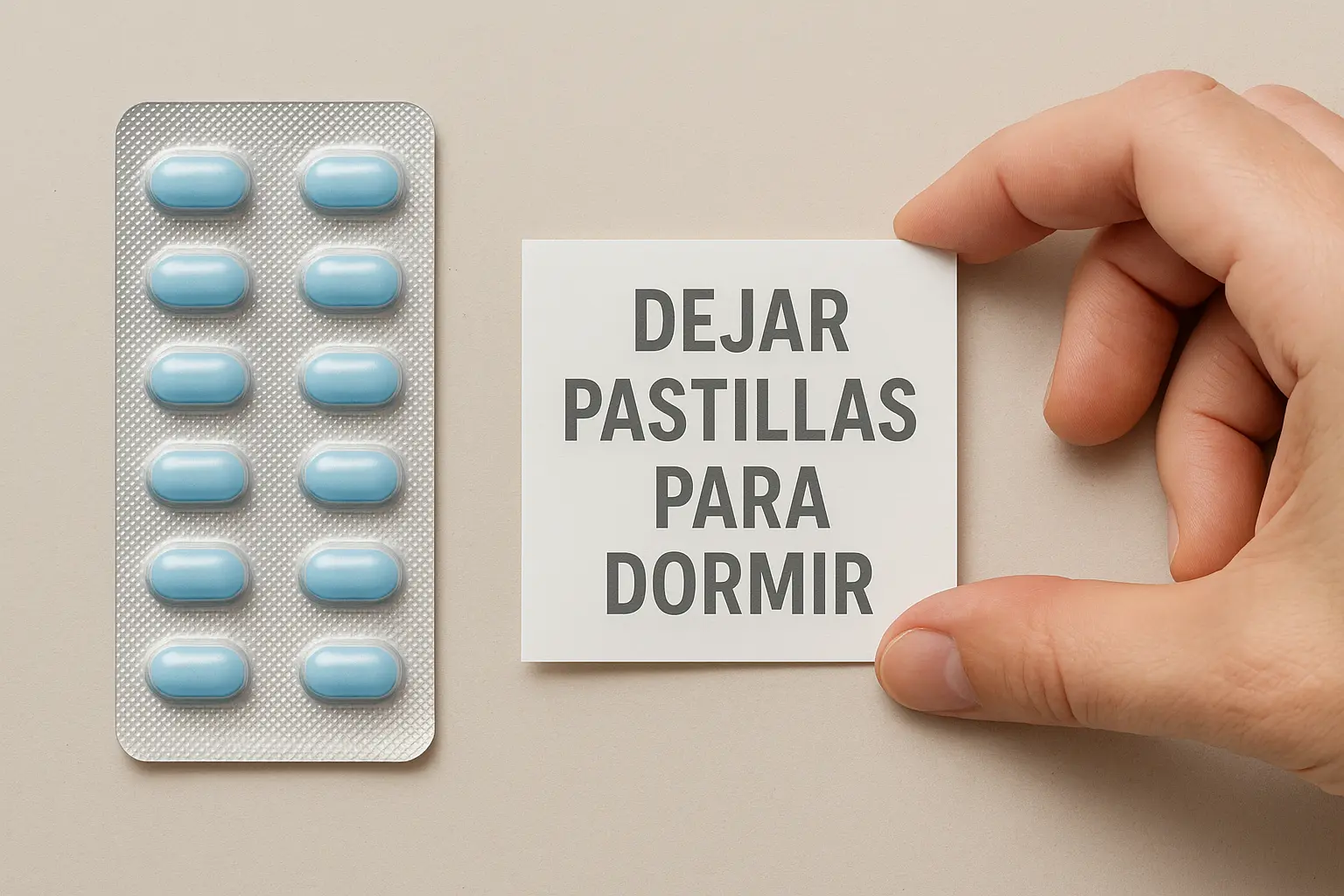
🌙💊 Sleep and insomnia · Z-drugs (zolpidem and zopiclone) · A 6–10-week exit plan
Zolpidem and zopiclone:
how to stop taking sleeping pills without suffering (and truly regain sleep)
By Dr. Marc Agraz — psychiatrist and integrative therapist. Online care throughout Spain.
The “wow” fact: in 2019 the FDA added a boxed warning about serious injuries and deaths associated with
complex sleep behaviors with certain “Z-drug” hypnotics (e.g., sleep-driving, cooking while asleep, severe falls), during episodes in which the person is not aware.
A gradual 6–10-week plan
CBT‑I = 1st line in Europe
8 h without driving after zolpidem
A quick clinical note: in the U.S., the FDA warning mentions zolpidem, zaleplon, and eszopiclone (not zopiclone). In Europe, zopiclone belongs to the same group (“Z-drugs”) and is managed with the same approach of caution, brief use, and gradual withdrawal when use has been sustained.
Does this happen to you?
If you check 2 or more, it is very likely that the hypnotic is no longer “occasional help” and has become part of the problem.
- I take it almost every night (for weeks/months) “just to be sure.”
- If I skip it one day, I experience rebound insomnia and anticipatory anxiety.
- I feel fear: “if there is no pill, I won’t function tomorrow.”
- I wake up with a hangover, clumsiness, dizziness, or worse concentration.
- I have memory gaps (fuzzy memories, “I don’t know how I got to bed”).
- I have had falls or scares when getting up at night.
- I have noticed unusual behaviors: eating/walking/talking as if on autopilot (without full awareness).
- On some nights I have “compensated” with alcohol (a bad combination for sleep and safety).
Important: this is not about “willpower.” It is about a method: gradual withdrawal + CBT‑I to retrain sleep.
If you have spent >3 months taking a hypnotic almost daily, it is worth having a sleep assessment and a
gradual withdrawal plan (6–10 weeks) with CBT‑I.
Online throughout Spain · A gradual plan · Follow-up · Coordination with your doctor if you need it
1) Risks that should concern us (realistically, without alarmism)
- Residual drowsiness the next day (reflexes, concentration, and balance).
- Memory gaps and automatic behaviors.
- Dependence psychological and physiological (sleeping without “help” becomes increasingly difficult).
- Falls and fractures, especially in older adults.
- Complex sleep behaviors (the most dangerous risk because of the lack of awareness).
Spain (safety): to reduce the risk of decreased alertness, a minimum interval of
8 hours is recommended between taking zolpidem and driving/operating machinery or working at heights.
2) Why it “hooks” you without your realizing it (it is not a lack of willpower)
Zolpidem and zopiclone can be useful in the very short term. The problem arises when use becomes chronic: sleep becomes more fragile, you experience rebound insomnia when you do not take them, and the brain learns an association: “if there is no pill, I don’t sleep.”
The good news: this is learning (conditioning + hyperarousal), and it can be unlearned. This is where CBT‑I (cognitive behavioral therapy for insomnia) is usually the central tool, and European guidelines recommend it as first-line treatment.

3) “So… why can’t I sleep without a pill?”
An unanchored rhythm
A variable wake-up time, weekends “without limits,” naps that steal sleep pressure.
Nighttime activation
Late screens, mental work at night, rumination, physical hyperalertness.
Bed = a battle
Going to bed “to try your luck,” watching the clock, staying awake in bed.
Conditioned fear
“If I don’t take it, I’ll be wrecked tomorrow”: fear becomes another source of insomnia.
4) A realistic plan to stop zolpidem / zopiclone (6–10 weeks)
Important: this is a general educational guide. Do not stop hypnotics “cold turkey.” The exact plan depends on dose, duration, age, comorbidities, and safety (falls, driving, etc.).
-
PHASE 1 — Preparation (7–14 days)
Before changing medication, we “prepare the ground”:- A fixed wake-up time (the true anchor of sleep).
- Natural light in the morning (even 10 min by a window).
- Naps: avoid them, or limit them to 20 min before 16 h.
- Screens: put them away 60–90 min before bed (for physiology and arousal, not moral reasons).
-
PHASE 2 — First reduction (week 3–4)
Make the first reduction and maintain it for 10–14 days (depending on tolerability). What to expect:- 1–3 nights of worse sleep.
- Anticipatory anxiety.
- Awakenings.
What NOT to do: increase the dose “just today,” substitute alcohol, or go to bed much earlier “to compensate.”
-
PHASE 3 — Gradual reductions + CBT‑I (week 5–8)
Reduce every 1–2 weeks (often by 10–25%, depending on the case) and activate the core of CBT‑I:- Sleep restriction: less time in bed → more consolidated sleep.
- Stimulus control: bed only for sleep/sex (no battles with the bed).
- Cognitive restructuring: “if I don’t sleep 8 h, I’ll fall apart tomorrow” → a common myth.
If intense rebound occurs: maintain the current dose for another 7 days and adjust the techniques. In general, avoid “going back up.”
-
PHASE 4 — Microreductions and stopping (week 9–10/12)
The final steps are often the most delicate: small reductions and patience.- Microreductions (e.g., 5–10%) every 7–14 days.
- Follow-up for 2–4 weeks after the last dose.
- Consolidate CBT‑I habits and a relapse prevention plan.
5) “What do I do if I don’t sleep at all one night?”
A bad night is not “fixed” by sleeping 12 hours the next day. In CBT‑I, a powerful tool is:
- Get up.
- Go to another room.
- A neutral activity for 10–15 min (dim light).
- Return when you feel sleepy.
6) Warning signs
Go to the emergency department / call 112 if there is: marked confusion, thoughts of harming yourself, severe tremor, delusions, or seizures (rare; the risk increases with abrupt withdrawal and comorbidities).
A gradual plan · Online CBT‑I · follow-up · coordination with your doctor if you need it
Key sources
-
FDA (2019): boxed warning about complex sleep behaviors
-
AEMPS/CIMA: safety and 8 hours before driving
-
European insomnia guideline (2023): CBT‑I as first-line treatment
Frequently asked questions
How long does it take to stop zolpidem or zopiclone?
For many people, a gradual plan of 6–10 weeks is reasonable, adjusting the pace according to dose, duration, and tolerability. In older adults or those with falls/residual drowsiness, it is usually slower and requires closer monitoring.
If I can’t sleep without a pill, does that mean I need it for life?
Not necessarily. There is often rebound + anticipatory fear + habits that perpetuate the problem. With a gradual plan and CBT‑I, the sleep system can be retrained.
Is switching to a benzodiazepine better for stopping it?
In general, it is not the most efficient strategy for most people. It is usually more straightforward to reduce the hypnotic itself with a plan and work on CBT‑I, always tailoring the approach to the clinical situation and safety.
Educational information: this does not replace an individual medical assessment. In a crisis or if there is a risk, call 112. In Spain, 24/7 support: Línea 024.


