


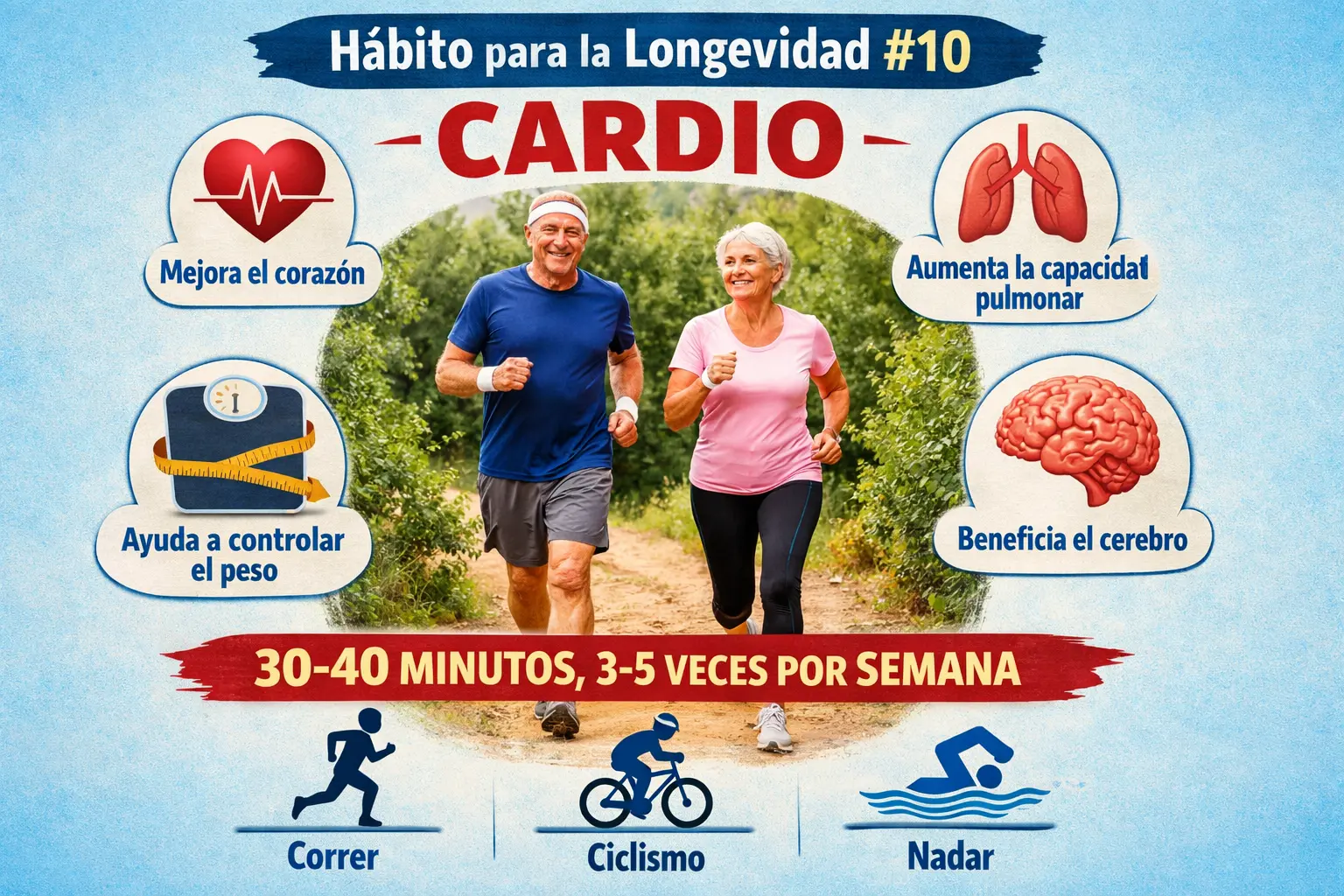
🧬⏳ Series: 10 habits that will help you live longer · Ranking · Habit #10
Habit #10 for a longer (and better) life:
Cardio… yes, but with a caveat almost no one tells you
If I say “cardio,” you may think of a treadmill, sweating, suffering a little… and feeling like a “good person” for a few hours. And if I say “longevity,” you may imagine supplements, biohacking, or impossible routines.
The twist: in my ranking of 10 habits for a longer life, I put cardio in position #10. Not because it is bad, but because it is important… yet not always the most decisive when compared with habits affecting metabolism, muscle, sleep, or circadian rhythm.
Minimum effective dose
Cardio as a nervous system regulator
No religion, no guilt
This is liberating: you can do cardio without making it your religion. It can be your foundation, your health insurance, and your emotional regulator… without making the mistake of thinking, “if I do cardio, everything is taken care of.” Today, we start the series at number 10, as agreed: Cardio.
First: what counts as “cardio” (and what does not)?
What does count as cardio
- Brisk walking.
- Cycling.
- Swimming.
- Dancing.
- Climbing stairs.
- Rowing or an elliptical.
- Doing physical chores at a steady pace (yes: cleaning “quickly, steadily, and without a break”).
What is not cardio (even if it looks like it)
- “Walking around the house” at phone-scrolling pace.
- Going to the gym to talk while holding a water bottle like a trophy.
- Taking 4,000 steps one day and 300 on the other six.
The guiding idea: cardio does not need heroics. It needs regularity.
Why I rank it #10… and why that is good news
Many people start with cardio because it is the most intuitive: “I move my body and sweat.” But longevity (and mental health) do not work on intuition: they work through levers.
Cardio is a very good lever, but…
- Sometimes it is less efficient than other changes (e.g., strength, sleep, circadian rhythm… we will cover these in the series).
- It is easy to use poorly: lots of effort, little strategy → you end up giving up.
A typical real-life pattern
- I start motivated.
- I demand too much of myself.
- I break down (injury, exhaustion, anxiety).
- I quit, blame myself, and the habit dies.
The “smart” alternative is different: enough cardio, sustained and compatible with your real life. Not heroic. Not punishing. Habit.
Cardio and longevity: what we know fairly reliably
At the population level, regular physical activity is associated with living longer and with less cardiovascular disease, metabolic disease, and functional decline. Public health recommendations usually specify a weekly minimum of moderate activity and remind us of something important: more is not always better if you get injured or burn out.
A realistic “wow” effect: cardio does not make you immortal. But it reduces the likelihood of reaching, too soon, a point where everything becomes an uphill struggle: chronic fatigue, pain, worse sleep, worse mood, more isolation. In other words: it gives you more room to maneuver.
Cardio and mental health: the “anxiety reliever” not sold in pharmacies
In psychiatry, something clinically wonderful happens when it is applied well: moderate, consistent cardio can regulate the nervous system. It is not magic. It is physiology + behavior.
1) Anxiety: from “alarm mode” to “rhythm mode”
Many anxious people live as if an internal siren were constantly on. Gentle cardio (e.g., brisk walking) trains tolerance of bodily sensations (breathing, pulse), regulates stress, and releases tension.
A clinical tip: start with “conversational” cardio: you can talk without getting out of breath.
2) Depression: an entry point to activation
In depression, the problem is not just “not doing things”: body and mind lose traction. Moderate cardio acts as behavioral activation: a small action that moves the system and creates a tiny change.
3) Insomnia: cardio as an anchor for the day
At an appropriate time (not close to bedtime), cardio may increase sleep pressure, reduce arousal, and improve rest. It does not replace insomnia treatment if the problem is serious, but it can be a multiplier.
The minimum effective dose (for people with lives, not athletes)
The mindset: “I am interested in what is sustainable, not heroic.”
-
A reasonable foundation (the classic approach)
Brisk walking 20–30 min, 4–5 days/week. -
Daily micro-cardio (underrated)
10–15 min a day. Yes: it works better than you imagine if you keep it up for months. -
If you are short on time
3 blocks of 8–10 min (morning, midday, afternoon). Less glamorous… and more real.
Cardio that helps you… and cardio that costs you
Cardio that usually helps
- Brisk walking.
- Gentle-to-moderate cycling.
- Gentle swimming.
- Dancing.
- Climbing stairs cautiously.
- Running errands on foot.
- Walking after meals (very useful if you struggle with glucose or weight).
Cardio that usually costs you (when it becomes a pattern)
- “Wearing yourself out” every time, without progression.
- Intense daily cardio without rest.
- Cardio as punishment (“because I ate poorly”).
- Cardio with an injury or persistent pain.
- Cardio that leaves you so activated it worsens sleep.
This is a very psychiatric point: if cardio comes from self-punishment, it usually does not last and leaves an emotional hangover. If it comes from self-care, it creates an identity: “I am someone who moves.”
A practical mini-guide: cardio for anxiety, low motivation, or embarrassment
-
If you are embarrassed to be seen
Start at home + the stairs (if safe), walking at quiet times, headphones, and a fixed route (same neighborhood, same loop, no decisions). -
If getting started is hard
The goal is not to “do cardio.” The goal is to put on your sneakers. Once that action becomes automatic, cardio follows on its own. -
If you quit because of guilt (“I could not do it today”)
You are not failing. You are practicing consistency. Every restart is part of the process.
Warning signs: when to stop and seek advice
If you develop pressure-like chest pain, significant dizziness, disproportionate shortness of breath, sustained palpitations with discomfort, severe joint pain, or an injury, it is advisable to stop and consult a healthcare professional to rule out medical problems and adjust the plan.
A closing thought I want you to remember
Cardio is like paying the rent on your health: it does not make you a millionaire, but it keeps you from one day finding yourself “evicted” from energy, mood, and functional capacity. It also has a quiet psychiatric value: it restores a sense of control.
Frequently asked questions
How much cardio should you do each week to be healthy?
It depends on age, fitness, and goals, but public health recommendations usually specify a weekly minimum of moderate activity. In clinical practice, the key is consistency and avoiding “all or nothing”: a little sustained activity is better than a lot that you abandon.
Which is better for anxiety: cardio or strength training?
Both may help. With high anxiety, many people tolerate starting with gentle cardio better (“conversational” brisk walking). Strength training can also be excellent, but usually requires more technical learning and well-planned progression.
Cardio in the morning or afternoon?
If you have insomnia, it usually helps to avoid intense cardio right before bed. If you have morning anxiety, early cardio sometimes regulates the day very well. What matters is choosing a schedule you can sustain.
A subtle call to action: if this is difficult, it is not a “lack of willpower”
If the problem is not “knowing what to do” but being able to do it (anxiety, low mood, insomnia, binge eating, phone dependence, rumination…), a clinical approach makes a difference. In consultation (including online), we can design a realistic plan that fits your life, symptoms, and history.
A realistic plan · no “all or nothing” · longevity + mental health · online throughout Spain
Informational content: it does not replace an individual medical assessment. In an emergency, contact the healthcare services in your area.


