


⚖️🧠 Forensic psychiatry · Psychological harm · Accidents and aftereffects
When the accident ends, but the nervous system never leaves it
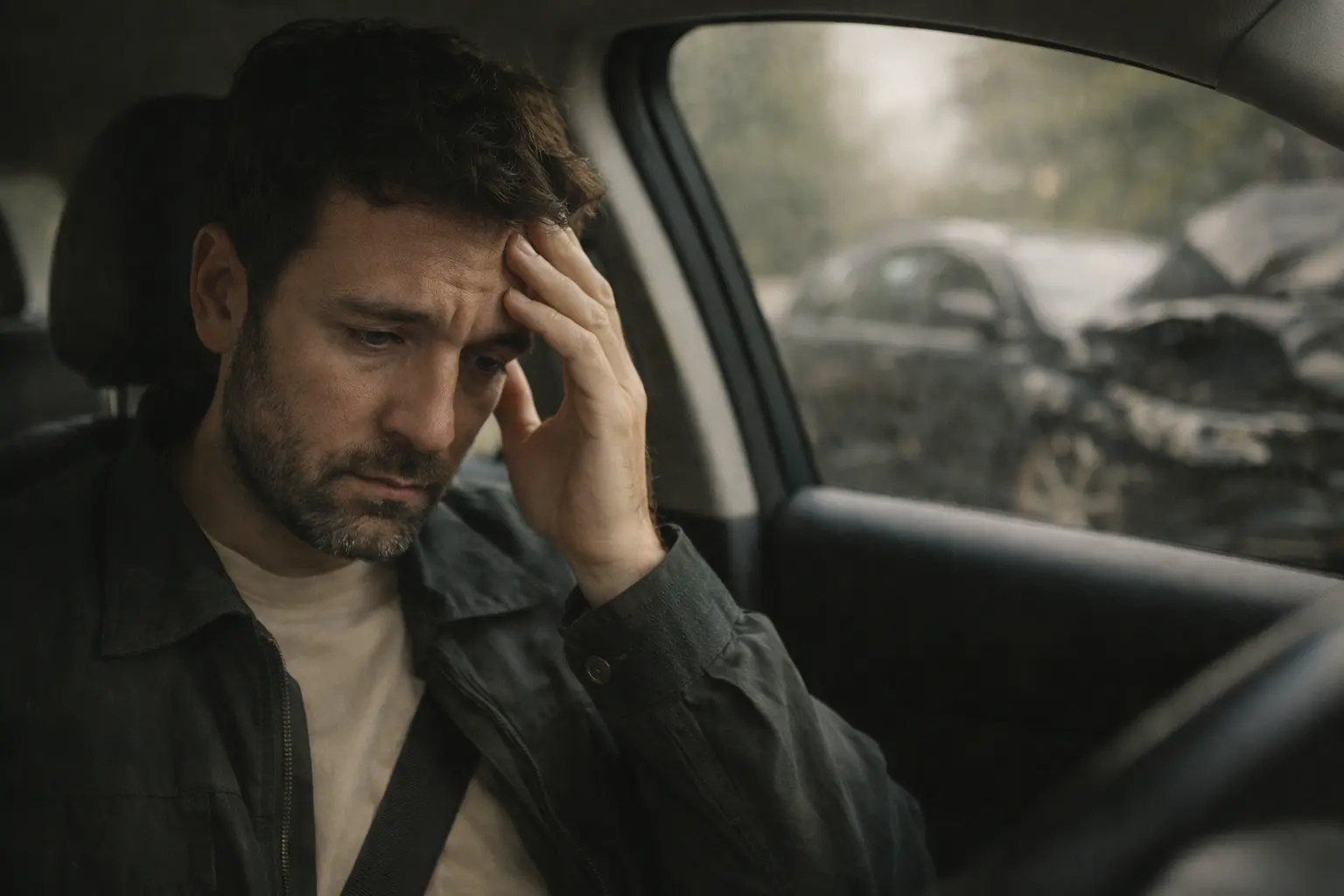
Some people emerge from an accident without a major visible fracture… yet are never quite the same. They do not drive. They sleep poorly. They relive the scene. Avoid the location. They experience anxiety, nightmares, startle responses, or a persistent sense that their body remains trapped in that moment. In these cases, the question is no longer only clinical. It also concerns expert assessment: can compensation be claimed for this?
In 45 seconds: yes, sometimes compensation for psychological harm can be claimed even without serious physical injury. But experiencing it is not enough: it must be properly demonstrated.
- The Supreme Court recently reinforced a key idea: personal, direct, and immediate psychological harm may give rise to civil liability if properly established and causally connected to the event.
- In expert assessment, the core issue is not just diagnosis, but causation, chronology, analysis of the preexisting condition, and functional impact.
- Not all distress after trauma constitutes established lasting aftereffects. We must distinguish between an expected reaction, temporary injury and stable psychological aftereffects.
- Traffic legislation requires the identification and measurement of lasting aftereffects and temporary injuries through a medical report.
- The best expert assessment is not the one that exaggerates most. It is the one that differentiates best.
2 Causation
3 PTSD and aftereffects
4 What the law requires
5 Injury vs. lasting aftereffects
6 What expert assessment demonstrates
7 Useful documentation
8 FAQ
9 Sources
In consultations and law offices, this question comes up increasingly often:
“Can I claim compensation for psychological harm if I look fine on the outside?”
The short answer is: sometimes yes. The important answer is this: only if it is demonstrated through method, chronology, clinical assessment, and sound expert evidence. That is where a serious psychiatric report completely changes a case’s value.
1) What has changed now: the Supreme Court has reinforced a key avenue
Supreme Court Judgment STS 115/2026, dated February 11 (ECLI:ES:TS:2026:485), has given this topic considerable traction because it reinstated the insurer’s civil liability for psychological harm suffered by someone who witnessed a fatal pedestrian collision. According to the legal summary circulated, the Supreme Court considered that harm personal, direct, and immediate, and held that a separate criminal conviction for psychological injury was not required for civil liability to arise if the harm was established and causally connected to the event.
The amount is not the only relevant point
The judgment reinstated compensation of 19,492.85 €, but what truly matters is the principle it establishes.
The underlying legal message
Psychological harm need not always accompany a major visible physical injury to be legally relevant.
An essential condition
It must be proven, clinically recognizable and demonstrate causation with the traumatic event.
In other words: yes, psychological harm can stand on its own. But it is not presumed. It must be established.
2) The heart of the case is not the diagnosis: it is causation
In forensic assessment, one phrase is worth remembering:
a diagnosis without causation has little value; a narrative of suffering without method has even less.
It is not enough to say “I haven’t been well since the accident.” Nor is a report containing the word “anxiety” enough. A good expert assessment must answer:
- whether there is a clinically significant psychological injury;
- whether it appeared after the event and in a coherent temporal sequence;
- whether that event is capable of explaining it;
- whether the clinical course is compatible with that hypothesis;
- whether there was a preexisting condition;
- and what the actual functional impact is on the person’s life.
3) Not all distress following trauma is already a lasting psychiatric aftereffect
After an accident, assault, or intensely traumatic event, initial reactions such as anxiety, sadness, startle responses, difficulty sleeping, or concentration problems are normal. NIMH specifically notes that many people have these reactions and most improve over time; only some develop PTSD or other persistent conditions.
Expected initial reaction
Anxiety, fear, insomnia, anger, difficulty concentrating, or intrusive images in the first days or weeks after the event.
Established disorder or lasting aftereffects
Persistent reexperiencing, avoidance, hyperarousal, nightmares, functional impairment, medication dependence, or a lasting impact on work, relationships, or autonomy.
This distinction is decisive: not every emotional reaction is compensable, and not every fright automatically becomes a lasting aftereffect. Confusing expected reactions, temporary injuries, and established lasting aftereffects weakens a case.
4) What traffic law requires and why the medical report matters so much
For traffic accidents, Spanish law does not leave this to intuition. The assessment system rests on two structural principles: full compensation for harm and its structured assessment by category.
Article 33
The personal injury assessment system is built around full, structured compensation for harm, rather than subjective impressions.
Article 7
The insurer’s reasoned offer or response must be supported by sufficiently detailed documentation, including the definitive medical expert report where appropriate.
Article 37.3
The reasoned offer is invalid if it does not include the definitive medical expert report allowing assessment of lasting aftereffects, temporary injuries, and their personal consequences, unless previously provided.
For lawyers and injured people, this is crucial: the case turns not only on the accident narrative, but on the quality of the medical expert evidence supporting it.
The 2025 reform also strengthened the out-of-court procedure, documentary transparency, and access to the Institutes of Legal Medicine and Forensic Sciences in certain disputes over the existence of injuries.
5) A subtle, useful development: not every persistent symptom is a permanent aftereffect
Law 5/2025 added a particularly useful clarification for forensic psychiatry to Article 134: temporary persistent symptoms remaining after stabilization but expected to resolve in the short or medium term continue to be assessed as temporary injuries until full recovery.
This is especially valuable in mental health, because many psychological injuries evolve in a gray area: the purely acute impact has passed, but it is not yet possible to state rigorously that stable, permanent aftereffects exist.
What undermines a case
Diagnosing lasting aftereffects too early, through impatience or evidentiary pressure.
What strengthens a case
Supporting the intermediate phase with technical honesty: recognizing persistent injury, assessing its duration, and waiting for consolidation when appropriate.
Temporary injury, lasting aftereffects, and causation: where many cases are won or weakened

Not every persistent symptom is an established lasting aftereffect: clearly distinguishing that boundary is part of an expert assessment’s value.
6) So, what does a good psychiatric expert assessment actually demonstrate?
-
That a genuine psychological injury exists
General suffering is not enough. The condition must be clinically defined: PTSD, adjustment disorder, a depressive episode, persistent anxiety, phobic avoidance, sleep disturbance with functional impact, or a combination. -
That there is a coherent temporal sequence
The report reconstructs when symptoms began, what appeared first, what happened next, and how the condition evolved. -
That the traumatic event is a sufficient cause or a significant contributing cause
Causation is not presumed: it is argued through chronology, clinical findings, documents, evolution, and exclusion of alternative hypotheses. -
That the preexisting condition is thoroughly analyzed
The aim is not to deny prior history, but to integrate it correctly. Preexisting vulnerabilities may be present and psychological harm may still be compensable if the traumatic event objectively precipitates or aggravates the condition. -
That there is functional impact
Harm supported by strong expert evidence is demonstrated through its effects: driving avoidance, inability to pass the accident location, hypervigilance, withdrawal, crying easily, severe irritability, declining performance, or occupational, sexual, or relationship difficulties. -
That the account withstands scrutiny
A good expert assessment does not simply accept a narrative: it examines it. It cross-checks emergency care, medical records, psychotherapy, treatment, police reports, employment documentation, and the clinical course.
7) Documentation that greatly strengthens a case
In these matters, seeking assessment early with good documentation makes a substantial difference. It is particularly helpful to have:
- emergency department or initial care records;
- reports from primary care, psychiatry, or psychology;
- medication started after the event;
- police reports or accident/assault documentation;
- a basic symptom chronology;
- medical leave records, if any;
- and functional evidence: stopping driving, ongoing insomnia, avoidance, declining performance, withdrawal, etc.
What usually undermines a good case is not a lack of suffering. It is a lack of method: requesting a report too early, waiting too long, treating a treatment report and expert assessment as equivalent, or expecting any anxiety following an event to be automatically compensable.
Another useful but little-discussed point: Article 36.3, following the 2025 reform, exceptionally recognizes relatives of deceased victims and severely injured people as injured parties for reimbursement of medical and psychological treatment for a maximum of twelve months for psychological disturbances caused by the accident.
8) Yes: compensation for psychological harm can be claimed without major physical injury. But it must be demonstrated
The Supreme Court has just reminded the system of something important: psychological harm can stand on its own and be legally relevant if properly proven. But good legal news should not be confused with relaxed evidentiary requirements.
Suffering alone is not enough. It must be demonstrated through chronology, clinical assessment, cross-checking, analysis of the preexisting condition, causation, and functional impact. In other words: a rigorous psychiatric expert assessment is needed.
SEO FAQ
Can compensation for psychological harm be claimed without fractures or serious physical injuries?
Yes, it may be possible if the psychological harm is personal, direct, immediate, and proven. The Supreme Court recently reinforced this in a case involving someone who witnessed a fatal pedestrian collision and suffered established psychological injuries.
What is the difference between temporary injury and lasting psychological aftereffects?
Not every persistent symptom is a lasting aftereffect. Since the 2025 reform, temporary persistent symptoms after stabilization that are still expected to resolve may continue to be assessed as temporary injuries until full recovery.
Is a medical expert report required?
Yes. The legal system requires lasting aftereffects and temporary injuries to be identified and measured through a medical report complying with the system’s rules.
What does psychological harm scoring assess?
The law states that psychophysical impairment scores are assigned according to clinical judgment, considering the intensity and severity of each lasting aftereffect.
Can family members also claim psychological support?
In certain cases, yes. The 2025 reform exceptionally recognizes reimbursement of medical and psychological treatment for relatives of deceased victims and severely injured people for up to twelve months for psychological disturbances caused by the accident.
9) When someone “looks fine on the outside,” clinical evidence matters more than ever
Are you a lawyer who needs a sound report in a case involving an accident, pedestrian collision, assault, or psychological aftereffects? Have you experienced a traumatic event and noticed that life has not returned to normal, even though you look fine on the outside? A good report does not promise results: it offers something more valuable—technical clarity, evidentiary strength, and a defensible clinical framework.
Psychological harm, PTSD, and causation · Lleida / Online · Court testimony if appropriate
10) Sources and further reading
Here is a useful selection for lawyers, injured people, and professionals seeking a sound legal and clinical grounding for the subject.
STS 115/2026: psychological harm in a witness to a fatal pedestrian collision
Legal summary of the Supreme Court Criminal Chamber ruling reinstating the insurer’s civil liability for personal, direct, and immediate psychological harm.
Article 33: full compensation and structured assessment by category
Structural principles of Spain’s personal injury assessment system for traffic accidents.
Law 5/2025 and reform of the compensation assessment system
Reform text strengthening reasoned offers/responses, access to expert evidence, harm to family members, and adjustments to the assessment system.
Articles 7.3.c) and 37.3: reasoned offer and definitive medical expert report
Key legal references explaining why reasoned offers and reasoned responses require sufficient medical expert support.
Article 36.3: medical and psychological treatment for relatives
This article exceptionally recognizes reimbursement of up to twelve months of medical and psychological treatment for certain relatives of deceased victims and severely injured people.
Article 134: temporary persistent symptoms
A key point for distinguishing persistent symptoms expected to resolve from established lasting psychological aftereffects.
2026 update of compensation amounts
Official resolution from Spain’s Directorate-General for Insurance and Pension Funds setting updated amounts under the system for 2026.
Posttraumatic reactions and PTSD
Useful clinical resource for distinguishing expected reactions following trauma from persistent, functionally significant PTSD.
Note: this article is informational and does not replace clinical evaluation or individual legal advice.
Severe suffering does not automatically mean compensable lasting aftereffects exist. Nor does the absence of major physical injury in itself rule out psychological harm.
The difference often lies in the quality of the causal link, clinical chronology, and strength of the medical expert report.
Next Wednesday in this forensic psychiatry series:
How psychological harm following medical negligence is actually assessed, what causation requires, and why many clinically severe cases fail for lack of expert assessment methodology.


