


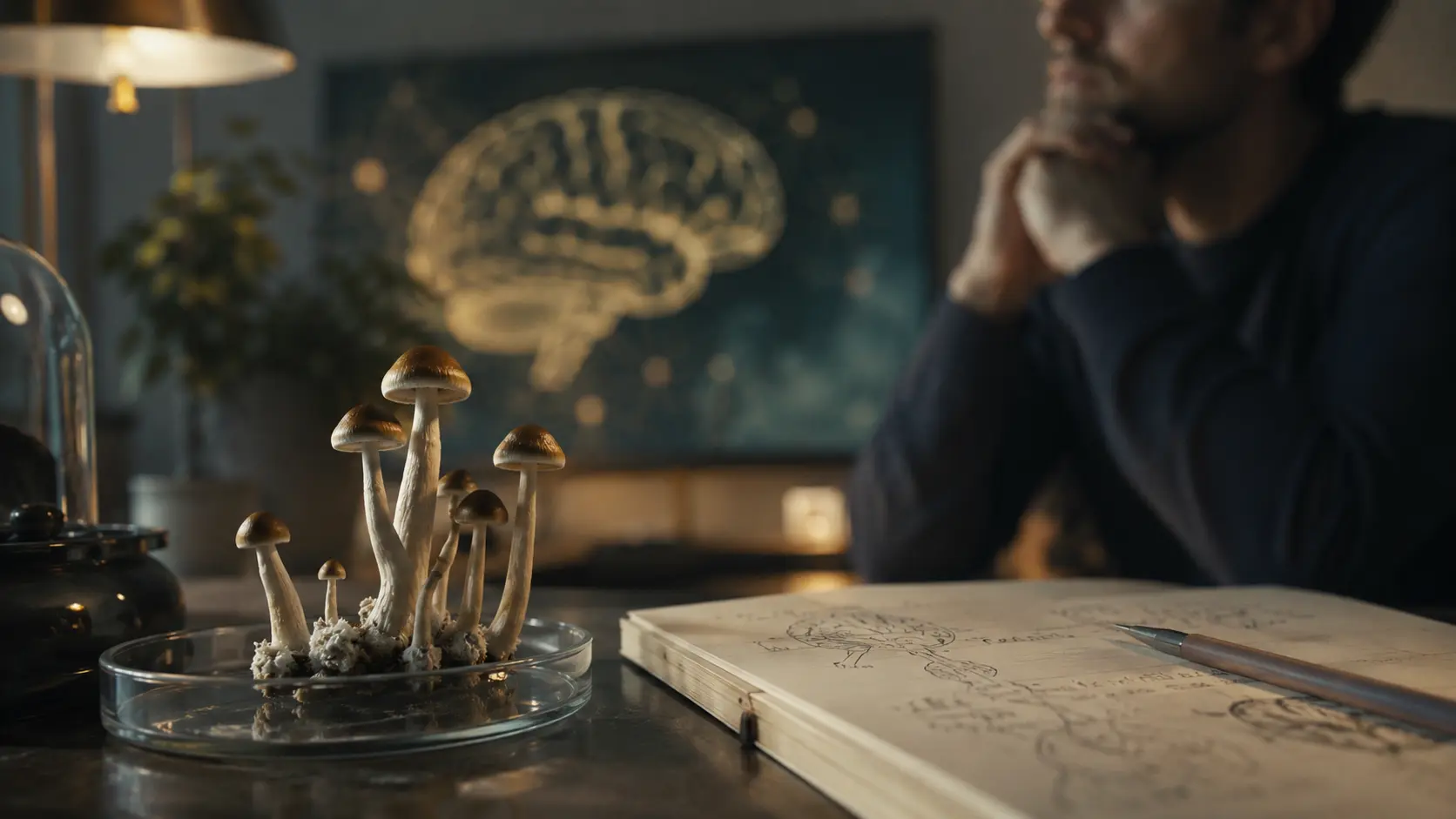
🍄🧠 Treatment-resistant depression · Psilocybin · Neuroplasticity · Assisted psychotherapy
Psilocybin, neuroplasticity, and treatment-resistant depression: what science says, what risks exist, and why a promising field should not be confused with a magic cure.
In recent years, one word has appeared increasingly often at conferences, in scientific journals, and in mental health headlines:
psilocybin. For some, it represents a therapeutic revolution. For others, it remains an immature field, surrounded by expectations, methodological biases, and risks if trivialized. Clinical reality, as almost always, lies somewhere between.
In 45 seconds: psilocybin is among the most interesting research directions in depression, particularly treatment-resistant depression. But it is not a magic solution, not a freely available treatment, and should not be sought outside regulated medical settings.
- Psilocybin is converted into psilocin and acts primarily on serotonin receptors, particularly 5‑HT2A.
- The current hypothesis is not simply “improving mood” but facilitating a temporary window of greater brain plasticity, psychological flexibility, and emotional processing.
- Relevant clinical studies generally investigate psilocybin + psychotherapy, not a substance taken at home.
- Major trials show a promising signal, but also limitations, results that are not always conclusive, and a need for longer follow-up.
- In people with bipolar disorder, psychosis, active substance use, acute suicidal ideation, or clinical instability, risk may be significant.
2 What psilocybin is
3 Loosening the circuit
4 Positive bias
5 Psilocybin + therapy
6 Trials
7 Methodological problem
8 Safety
9 Spain
10 FAQ
Interest in psilocybin is gaining renewed momentum following a review published in 2026 in Acta Neurológica Colombiana, titled “Psilocybin in depression: neurobiological mechanisms and cognitive changes”. The review summarizes psilocybin’s role in serotonin 5‑HT2A receptors, reorganization of brain networks, emotional processing, and psychological flexibility.
The question many patients ask is understandable:
If I have been depressed for years, tried treatments, and remain unwell… could psilocybin help me?
The honest answer is: perhaps in the future, in highly regulated settings, for selected profiles, and always with psychotherapy and medical supervision. Today, however, understanding what we know, what we do not know, and what real options exist is what matters.
1) Depression is not simply “being sad”: it is a trapped brain
Depression is not limited to sadness. It may involve loss of pleasure, extreme tiredness, guilt, mental slowing, insomnia or hypersomnia, loss of hope, bodily pain, isolation, irritability, and difficulty imagining a different future.
Sadness is not everything
Many people with depression describe themselves not as “sad” but as dulled, blocked, without energy or pleasure, or unable to imagine a future.
Effective treatments
The WHO notes that effective treatments for depression exist, including psychotherapy and medication, particularly for moderate and severe conditions.
Treatment-resistant depression
Some patients do not respond sufficiently to appropriately indicated treatments. Generally, treatment-resistant depression refers to inadequate response after at least two properly tried antidepressant treatments.
This is where new treatment directions have emerged: esketamine, neuromodulation, more intensive integrative models, and, in research, psychedelic-assisted therapies.
2) What psilocybin really is
Psilocybin is a psychedelic compound present in some mushrooms of the genus Psilocybe. In the body, it is converted into psilocin, its active metabolite, which primarily interacts with serotonin receptors, particularly 5‑HT2A.
But that statement, though correct, falls short. Interest in psilocybin is not simply about “raising serotonin,” as though it were a conventional antidepressant. The current hypothesis goes deeper: it might induce a temporary window of greater brain plasticity, facilitating changes in emotional, cognitive, and relational patterns when administered within a structured psychotherapeutic process.
Simply put: psilocybin is being investigated not only as “a drug that improves mood” but as a tool that might help the brain escape rigid patterns.
3) The most useful metaphor: loosening the circuit rather than “switching off” depression
In depression, many people describe a recognizable experience: they feel their mind keeps following the same routes.
- “I am a failure.”
- “I will not get better.”
- “There is no point trying.”
- “Everything depends on me.”
- “I always end up in the same place.”
Psilocybin appears to act partly on that rigidity. Some neuroimaging studies have found changes in brain connectivity, global integration, and networks linked to the self, emotion, and self-regulation.
One simple explanation would be:
depression narrows the mental map; psilocybin, under controlled conditions, might temporarily broaden it so therapy can work more effectively.
But one word needs emphasis: might. The science is promising, not definitive.
4) Cognitive changes: the “positive bias” that interests psychiatrists
One of the most interesting points in the review from Acta Neurológica Colombiana is the concept of positive bias in emotional processing. In depression, the brain tends to detect negatives more easily: threat, failure, rejection, guilt, loss. That bias is not voluntary; it forms part of the illness itself.
Depressive filter
A depressed person does not “choose” to see negatives. Their emotional processing system is biased toward threat, failure, and loss.
Therapeutic window
If patients are less captured by their usual depressive filter for a period, psychotherapy can work with greater flexibility.
This does not mean “seeing life through rose-colored glasses.” It means something more clinically relevant: patients might become less captured by their usual depressive filter for a period.
5) Psilocybin + psychotherapy: the molecule does not work alone
This is one of the article’s most important ideas and one most misunderstood on social media.
Psilocybin is not being investigated as a pill taken at home to “cure” depression.
Most relevant clinical studies investigate it within an assisted psychotherapy model.
-
Clinical selection
Assess diagnosis, risk, history, comorbidities, medication, stability, and contraindications. -
Preparation
Prior work on expectations, safety, therapeutic goals, the relationship with the team, and understanding the process. -
Supervised session
Administration in a controlled setting, with professional support and safety protocols. -
Integration
Subsequent sessions to process the experience, translate it into real changes, and prevent it from remaining an isolated event. -
Follow-up
Monitor improvement, relapses, adverse effects, suicide risk, functioning, and continuity of treatment.
The treatment under investigation is not “taking psilocybin.” It is a clinical package: patient selection, preparation, safety, a controlled setting, support, integration, and follow-up.
6) What major trials say: promise without triumphalism
The evidence is interesting but should be read precisely.
NEJM 2021: psilocybin vs. escitalopram
The trial did not demonstrate a significant difference in the primary outcome between treatments, although several secondary outcomes favored psilocybin.
NEJM 2022: treatment-resistant depression
A single 25 mg dose reduced depressive symptoms more than a 1 mg dose over three weeks in treatment-resistant depression, but the study itself called for larger, longer trials to clarify effectiveness and safety.
JAMA Psychiatry 2026: EPISODE
The randomized trial in treatment-resistant depression did not reach significance for its primary outcome, although it showed clinically relevant signals in secondary variables and safety data requiring continued caution.
The most considered conclusion would be: psilocybin has a real therapeutic signal, particularly in treatment-resistant depression, but the “immediate revolution” narrative moves faster than definitive evidence.
7) The major methodological problem: a psychedelic is almost impossible to “blind”
In drug research, double-blinding matters greatly: neither patient nor investigator should know which treatment is received. With classic psychedelics, however, this is very difficult. The subjective experience is so intense that many people identify whether they received the active drug.
In March 2026, Science Media Centre Spain reported a meta-analysis in JAMA Psychiatry suggesting that psychedelic-assisted therapies were not clearly superior to traditional antidepressants when compared under conditions of treatment awareness, emphasizing problems with masking, expectations, and bias.
This does not invalidate the field. But it requires intellectual honesty. In medicine, a therapeutic promise does not need propaganda. It needs good trials, good safety, good protocols, and responsible implementation.
8) Safety: it may be dangerous for some people
Psilocybin is not a trivial substance. In clinical settings with selection and supervision, adverse effects are usually manageable, but acute anxiety, confusion, panic, transient worsening of distress, nausea, headache, and intense emotional reactions may occur. Outside clinical settings, risk increases.
From a psychiatric perspective, some profiles require extreme caution.
The message is not “never psilocybin.” It is: never without clinical selection, never without supervision, and never as an experiment in a vulnerable person.
- bipolar disorder or a history of mania/hypomania;
- previous psychosis or a strong family history of psychosis;
- active substance use;
- acute suicidal ideation or clinical instability;
- personality disorders with severe dysregulation;
- unstabilized complex trauma;
- lack of a support network;
- self-medication or use at unregulated retreats.
Psilocybin and depression: mechanisms, evidence, and clinical cautions

The real interest in psilocybin is not the psychedelic effect but the potential opening of a therapeutic window requiring rigorous study, safety, and clinical support.
9) The situation in Spain: research, not self-prescribing
In Spain, psilocybin has been investigated in authorized clinical trials; for example, the European register lists a Spanish trial authorized by AEMPS on psilocybin’s safety and effectiveness in participants with treatment-resistant depression.
But this does not mean psilocybin is freely available as treatment or should be sought outside regulated settings. In Europe, implementing psychedelic therapies requires not only regulatory approval but health technology assessment, safety protocols, team training, patient selection, and funding models.
In practical terms for a patient in Spain:
you should not seek psilocybin independently, consume mushrooms, or attend nonclinical retreats to treat depression. The appropriate approach is to consult a psychiatrist, assess whether depression is truly treatment-resistant, and explore safe, available options.
10) The trend risk: confusing hope with a shortcut
Every era has its “miracle treatment.” First one molecule, then another. Then stimulation, ketamine, microbiota, psychedelics, artificial intelligence. All may contribute. None should become dogma.
Treatment-resistant depression is rarely resolved through one component.
A thorough reassessment should review:
-
✓
Diagnosis
Whether this is truly major depression or hidden bipolar disorder, ADHD, trauma, substance use, autism, or a personality disorder.
-
✓
Previous treatments
Whether doses, duration, adherence, combination, and follow-up were appropriate.
-
✓
Sleep, body, and context
Insomnia, pain, inflammation, endocrinology, nutritional deficiencies, isolation, loneliness, or chronic stress.
-
✓
Advanced options
Esketamine, neuromodulation, specific psychotherapy, integrative approaches, and clinical trials when appropriate.
11) What a patient with treatment-resistant depression can do today
If someone has had depression for years, tried several treatments, and feels trapped, the most useful response is not rushing to search for “psilocybin near me.” It is a thorough psychiatric reassessment.
- Is this truly major depression, or is another diagnosis primary?
- Is there treatment resistance, or are treatments poorly optimized?
- Is bipolar disorder, trauma, substance use, or ADHD present?
- Which treatments have been tried, and how?
- What roles do sleep, inflammation, lifestyle, and social networks play?
- Are there approved options or referral pathways not yet explored?
- Are suitable clinical trials available?
That process is less spectacular than a psychedelic headline but usually much more useful.
12) My clinical position
High scientific interest, cautious enthusiasm, no trivialization.
I find this treatment direction fascinating because it addresses not only symptoms but psychological flexibility, emotional regulation, and reorganization of rigid patterns. That approach fits serious integrative psychiatry well: biology, psychotherapy, subjective experience, context, and meaning.
But I also believe the field must protect itself from its own hype. Selling it as a “natural cure” will harm vulnerable patients. Dismissing it through prejudice may hinder valuable research. The right approach is to advance rigorously, safely, and with clinical selection.
Psilocybin should not become a trend. It should be studied as medicine.
13) This is about plasticity, therapy, and responsibility rather than “mushrooms for depression”
The 2026 review of psilocybin, neurobiological mechanisms, and cognitive changes offers a compelling idea: psilocybin might promote changes in brain connectivity, emotional processing, positive bias, psychological flexibility, and self-regulation.
That is the real point of interest. Not the spectacle of the psychedelic experience. Not sensationalism. Not an easy headline.
The real interest is that, in some patients, we may be able to open a therapeutic window in which the brain stops repeating the same depressive story.
But that window must be opened through science, not improvisation.
SEO FAQ
Does psilocybin work for depression?
Evidence suggests antidepressant potential, particularly in treatment-resistant depression and within assisted psychotherapy, but larger trials, longer follow-up, and better-standardized protocols are still needed.
Is psilocybin better than antidepressants?
This cannot be stated generally. In the trial against escitalopram published in NEJM, no significant difference was demonstrated in the primary outcome, although some secondary outcomes favored psilocybin.
How does psilocybin act in the brain?
It is primarily studied for its action on 5‑HT2A receptors, neuroplasticity, changes in brain connectivity, emotional processing, and psychological flexibility.
Can psilocybin be taken at home to treat depression?
No. Psilocybin may carry significant psychiatric risks, particularly for vulnerable people, and should be investigated or used only in regulated, supervised clinical settings.
Is psilocybin therapy available in Spain?
AEMPS-authorized clinical trials have been conducted in Spain, but that does not equal unrestricted clinical availability. The responsible approach is to consult a psychiatrist and assess approved options or suitable clinical trials.
Which patients might not be good candidates?
People with bipolar disorder, a history of psychosis, a significant family history of psychosis, active substance use, clinical instability, or acute suicidal ideation require particular caution and expert assessment.
What should I do if I have treatment-resistant depression?
A complete psychiatric reassessment is most advisable: diagnosis, previous treatments, comorbidities, sleep, trauma, substance use, medication options, psychotherapy, esketamine, neuromodulation, or clinical trials when appropriate.
14) With treatment-resistant depression, you need a complete clinical formulation rather than chasing trends
Do you have treatment-resistant depression, frequent relapses, or a sense of having tried several treatments without recovering your life? Are you interested in what is true—and what is not—about emerging treatments such as psilocybin, esketamine, neuromodulation, or integrative approaches?
A specialist psychiatric assessment can help clarify diagnosis, review previous treatments, and design a realistic, safe, personalized plan.
Treatment-resistant depression, anxiety, trauma, sleep, and advanced treatment options · Lleida / Online
15) Sources and further reading
Selected recent, relevant sources to follow the topic rigorously, without hype or trivializing risks.
Psilocybin in depression: neurobiological mechanisms and cognitive changes
Review of 5‑HT2A, brain connectivity, emotional processing, self-regulation, and positive bias.
Depression fact sheet
Official WHO summary of depression prevalence, symptoms, and treatments.
Therapeutic Use of Psilocybin in Depression
Systematic review of clinical evidence in depression, with rapid, sustained effects in many studies but methodological limitations.
Psilocybin versus escitalopram for depression
Comparative trial showing no significant difference in the primary outcome, although several secondary outcomes favored psilocybin.
Single-dose psilocybin for treatment-resistant depression
Single-dose trial in treatment-resistant depression: 25 mg showed greater symptom reduction than 1 mg at 3 weeks, with a need for further studies.
EPISODE randomized clinical trial
Trial in treatment-resistant depression with psilocybin 25 mg and adjunctive psychotherapy. Nonsignificant primary outcome, with secondary signals and relevant safety data.
Psychedelics, antidepressants, and double-blinding problems
Spanish summary of a meta-analysis in JAMA Psychiatry on psychedelics versus antidepressants and masking biases.
Risks identified in psychedelic therapies
Journalistic summary of risks such as acute anxiety, panic, confusion, mood deterioration, mania, or psychosis in vulnerable profiles.
Psilocybin trial in treatment-resistant depression in Spain
European register of a trial in Spain authorized by AEMPS on psilocybin’s safety and effectiveness in treatment-resistant depression.
Pathway to implementation in European healthcare systems
Review of implementation challenges in Europe: EMA approval, HTA assessment, protocols, safety, training, and funding.
Suicidal behavior support
Official Spanish Ministry of Health resource for people with suicidal ideation, family members, and loved ones.
Note: this article is informational and does not replace individual medical assessment.
It does not recommend psilocybin use outside clinical trials or regulated medical settings. Self-medication or use at nonclinical retreats may be dangerous, particularly for vulnerable people.
If there are thoughts of death, self-harm, or a suicidal crisis, in Spain you can call 024 or go to emergency care / 112.


