


🎵 Culture Friday · Scientific curiosities · Music · Neuroscience
Why does a song give you goosebumps?
What genetics, dopamine, and your memories can explain about that shiver
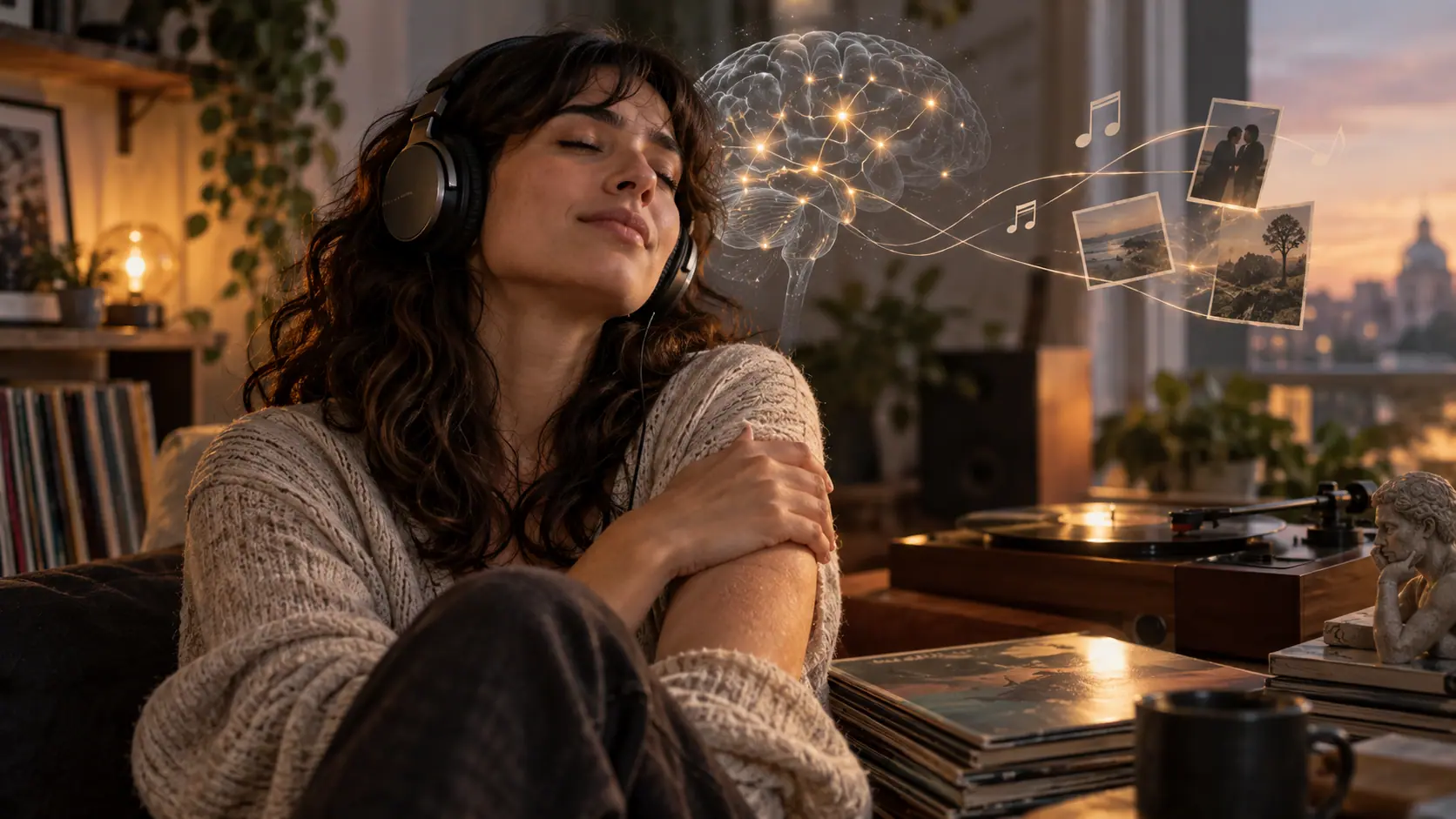
You are listening to a song you have known for years.
You know that moment is coming: the voice rises, an instrument comes in, or the chorus you have been waiting for arrives. For a few seconds, you feel a shiver down your spine, a tingling sensation, or goosebumps.
You look at the person beside you.
They carry on calmly, as if nothing has happened.
How can the same sequence of sounds stir such intense emotion in one person and leave another almost unmoved?
Researchers study this phenomenon as aesthetic chills, also known as frisson. They can occur with music, but also during a movie scene, a speech, or an encounter with a work of art. It is an emotional experience with physical manifestations, although it does not always produce visible goosebumps.
And science is beginning to understand why we do not all experience it in the same way.
Supporting references: [1] Aesthetic chills.
A 2026 study found clues in DNA
On February 18, 2026, PLOS Genetics published a study using genetic data and questionnaires from 15,606 people in the Netherlands.
The team studied their tendency to experience chills in response to music, poetry, and art. It found a genetic contribution, but also considerable room for other factors.
Up to 29% of the differences were associated with family relatedness effects; only about a quarter of that contribution was attributed to the common genetic variants analyzed. It would be incorrect to interpret this as “29% of your emotion is written in your genes.”
The study also relied on questionnaire responses: it did not directly observe thousands of people listening to the same song.
The finding helps researchers study predispositions. It does not identify a single “goosebumps gene” or predict which music will move each person.
Supporting references: [2] Genetics and relatedness.
Music can activate reward without offering anything material
A song provides neither food nor money. Yet it can be extraordinarily rewarding.
An experiment published in PNAS in 2019, conducted in Barcelona, studied 27 healthy participants and used medications to alter dopamine signaling under controlled conditions, comparing the effects with a placebo. The changes affected both musical pleasure and the motivation to listen to the music again.
This provides evidence that dopamine is involved in musical reward.
But it would be too simplistic to conclude that a song is a “dopamine shot.” Pleasure also depends on how we interpret music, our expectations, learning, and personal associations. The study itself suggests that interacting processes and systems are involved, rather than a single molecule explaining the entire experience.
The experiment was not suggesting that people take medication to enjoy songs more, either. It was investigating a mechanism.
Understanding the chemistry of an emotion does not capture its full meaning.
Supporting references: [3] Dopamine and music.
Sometimes we are not just listening to a song: we are listening to a chapter of our lives
Imagine hearing a melody associated with a trip, a loved one, or your teenage years.
In that case, music can act as a cue that helps retrieve autobiographical memories. A small functional MRI study observed the involvement of brain networks associated with personal memory when participants listened to meaningful songs from their past.
That is why two people can share a pair of headphones without sharing the same experience.
For one, it is a pleasant melody.
For the other, it may be the last night of a summer or a conversation they never forgot.
A chill does not have to come solely from a spectacular note. Research on musical memory helps us understand that sound can also bring part of our life story to mind. That does not mean every chill requires a specific memory.
Supporting references: [4] Music and memory.
Related reading: Bilingualism and Alzheimer’s: does speaking Catalan and Spanish protect the brain?.
What if music never gives me chills?
There is no need to turn a scientific curiosity into a test of sensitivity.
Studies have even identified healthy people with specific musical anhedonia: they understand music but derive little pleasure from it, while retaining their response to other rewards. In a study published in Current Biology, this characteristic was observed without depression or generalized anhedonia.
Supporting references: [5] Specific musical anhedonia.
So, not being moved by a song does not show that someone has a psychological problem. Nor does it mean they are less empathetic or lack a rich emotional life.
There is an important difference between:
“Music has never interested me very much.”
And:
“I used to enjoy music, my friends, and my hobbies; for weeks now, almost nothing has given me pleasure.”
The second situation deserves attention. A persistent loss of interest or pleasure in different activities can be part of depression, especially when accompanied by changes in sleep, energy, concentration, or functioning. It is not diagnosed by listening to a song: the whole experience is assessed.
Supporting references: [6] Loss of interest and pleasure.
Can we use music to support mental health?
It can have a place, but it is worth distinguishing listening to music for pleasure from a music therapy intervention.
In a trial involving 79 people with depression, adding individual music therapy to usual care led to greater improvements in depressive symptoms, anxiety, and functioning at three months than usual care alone. This was a structured intervention with therapy sessions, not a recommendation to listen to a playlist.
The result supports researching and using specific interventions when indicated. It does not show that seeking chills cures depression or that any selection of music has the same effect.
Supporting references: [7] Music therapy trial.
From my integrative perspective, I would not present culture as a replacement for psychotherapy or necessary medication. I am also interested in which activities the person wants to return to: listening to music, playing an instrument, dancing, reading, or sharing something meaningful with others again.
Recovery should not be measured only by the symptoms that disappear, but also by the relationships, autonomy, and sense of direction in life that can be regained.
Not everything that helps us feel well needs to become a treatment. But treatment should not lose sight of what makes being well meaningful, either.
An idea for this weekend: really listen to a song
I suggest taking a short pause, not a diagnostic test.
Choose a song you like and listen to it all the way through at a comfortable volume, without replying to messages or working on another task at the same time.
As it plays, notice three things:
- Anticipation: is there a moment you are waiting for?
- Your body: do you notice emotion, an urge to move, calm, or a chill?
- Memory: does a person, a scene, or a period of your life come to mind?
Do not try to force a reaction. If nothing special happens, you have not failed the exercise.
Afterward, you can share the song with someone and ask what they felt, without first telling them what they should feel. You may discover that the same passage has completely different meanings for each of you.
If a song feels too painful, you do not need to force yourself to finish it.
The idea is not to measure how moved you feel. It is to pay attention to how you listen.
And here is a question to take into the weekend:
Which song would you choose to explain part of your life without having to put it into words?
When it is not just music: “I haven’t been enjoying anything lately”
If you have stopped enjoying many activities and the change persists, especially if it affects your sleep, energy, relationships, or work, it is worth seeking an assessment. Loss of pleasure deserves to be heard; it should not automatically be interpreted as laziness or a lack of willpower.
Supporting references: [6] Loss of interest and pleasure.
During a consultation, we can explore when the change began, what other difficulties accompany it, and which medical, emotional, or treatment-related factors need to be reviewed.
Dr. Marc Agraz · Integrative psychiatry
In-person care in Lleida and online consultations when clinically appropriate.
Sources and further reading
Supporting references for the studies and concepts discussed in this article. The studies on chills, reward, and memory investigate mechanisms; the music therapy trial evaluates a structured intervention, not a playlist.
Aesthetic chills and physical responses
Bannister S. Distinct varieties of aesthetic chills in response to multimedia. PLOS ONE. 2019;14(11):e0224974. A study of the diversity of experiences described as aesthetic chills.
Genetic underpinnings of chills from art and music
Bignardi G, Admiraal D, Eising E, Fisher SE. PLOS Genetics. 2026;22(2):e1012002. Research cited in the manuscript on genetic and familial contributions to the tendency to experience chills.
Dopamine and musical reward
Ferreri L and colleagues. Dopamine modulates the reward experiences elicited by music. PNAS. 2019;116(9):3793–3798. The pharmacological experiment cited in the section on musical pleasure.
Music and autobiographical memories
Janata P. The neural architecture of music-evoked autobiographical memories. Cerebral Cortex. 2009;19(11):2579–2594. Functional MRI research on songs and personal memory.
Specific musical anhedonia
Mas-Herrero E and colleagues. Dissociation between musical and monetary reward responses in specific musical anhedonia. Current Biology. 2014;24(6):699–704. The study cited on differences in musical pleasure.
Loss of interest or pleasure and assessment of depression
National Institute of Mental Health. Depression. An informational resource on symptoms, functional impact, and clinical assessment, providing context for a persistent loss of pleasure across different activities.
Individual music therapy added to usual care
Erkkilä J and colleagues. Individual music therapy for depression: randomised controlled trial. The British Journal of Psychiatry. 2011;199(2):132–139. A trial of a structured therapeutic intervention.
This article is for educational purposes. Not experiencing chills from music does not constitute a diagnosis, and listening to songs does not replace clinical care when it is needed.


