


🫀 Anxiety and cardiovascular health · Palpitations · Panic · Cardiophobia
Palpitations and anxiety: when fear of a heart attack takes over your life
Your heart has become the focus of your attention. What should be reviewed, and how can you regain peace of mind without ignoring symptoms?
Imagine this fictional situation.
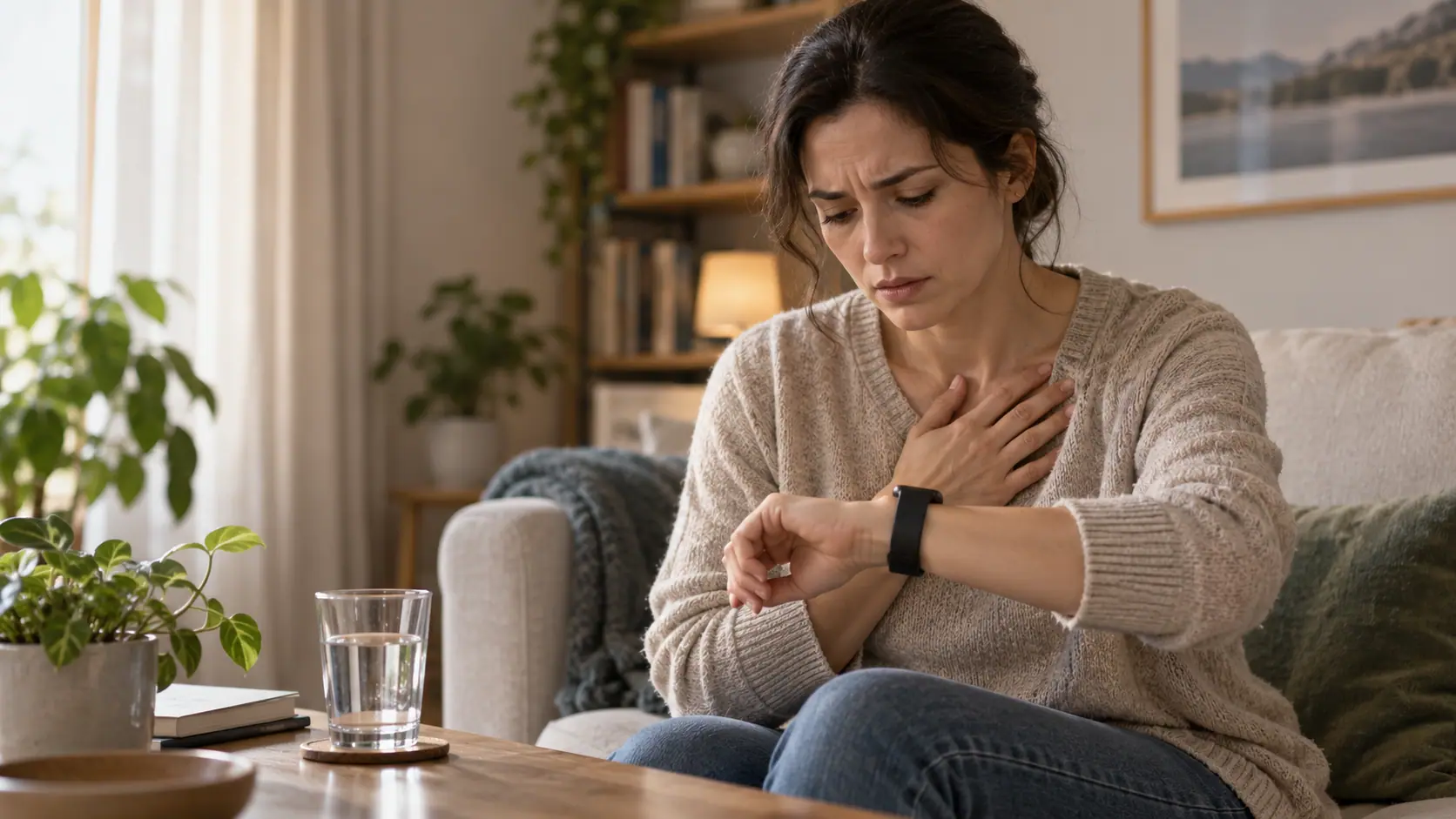
Someone notices a stronger heartbeat while sitting down. They look at their watch. Check their pulse. Wait a few seconds and look again.
The number has gone up.
“What if something really is wrong this time?”
They get up, walk around the room, and search online. They find reassuring explanations, but also a story that worries them. They end up asking their partner to stay nearby.
They have already had a medical assessment. Yet the reassurance does not last long. They have stopped running, avoid being alone, and do not go to bed without first checking that everything seems fine.
The problem is no longer confined to the chest.
It takes up the entire day.
This experience raises two questions that need to be addressed together: have the physical symptoms been adequately investigated? And what treatment is needed for the fear that is shaping everyday life?
Before continuing: if you have new or persistent chest pain or pressure, significant difficulty breathing, fainting, or a sudden deterioration, seek urgent care. If a heart attack is suspected, call 112 and do not drive yourself. Do not wait for your watch to confirm an abnormality or use this article to rule out an emergency.
Supporting references: [1] Warning signs.
Why we are discussing this this week
World Heart Day takes place every September 29. In 2026, the World Heart Federation is continuing its “Don’t Miss a Beat” campaign, focused on recognizing cardiovascular warning signs and improving prevention.
Supporting references: [2] World Heart Day.
Recognizing warning signs matters. But recognizing them does not mean monitoring every heartbeat all day.
On September 2, the American Medical Association addressed precisely this tension: devices can provide useful information and encourage healthy habits, although alerts, scores, and constant monitoring can also cause excessive worry in some people.
Supporting references: [3] AMA · Devices and health.
The answer is not choosing between looking after your heart and your mental health.
It is learning what information needs medical attention, what monitoring is indicated, and when checking has become part of the suffering.
What cardiophobia is
The term cardiophobia describes an intense, persistent fear of having heart disease, especially a heart attack.
The person may interpret bodily sensations as signs of danger, repeatedly seek reassurance, and avoid activities they believe could trigger a problem. The fear may continue despite a reassuring medical assessment and explanations.
Supporting references: [4] Cardiophobia.
This does not mean they are pretending.
The sensations can be real. So can the fear. What needs assessment is the relationship between those symptoms, their interpretation, and the behaviors used to try to stay safe.
Naming the fear also does not automatically settle the diagnosis. It may be necessary to distinguish health anxiety, panic attacks, other psychological difficulties, and coexisting medical problems.
Not every fear of a heart attack is a phobia. Not every palpitation is anxiety. And having anxiety does not prevent physical illness.
Can anxiety cause palpitations?
Yes. Anxiety and stress can make heartbeats more noticeable and increase heart rate. Exercise, insufficient sleep, certain medications, caffeine, nicotine, alcohol, and other substances also play a role. Palpitations can have medical causes too, such as arrhythmias, anemia, or thyroid disorders.
Supporting references: [5] NHS · Palpitations.
The word palpitation describes a sensation; it does not, by itself, identify the cause.
A particularly distressing cycle can occur in panic: the heartbeat is noticed, interpreted as a threat, and fear further increases bodily arousal. The NIMH describes this mechanism as a possible part of the panic cycle.
Supporting references: [6] NIMH · Panic.
A simplified example would be:
“I notice a heartbeat” → “It could be a heart attack” → fear increases → I notice my body more → “This confirms that something is wrong.”
Understanding this cycle does not justify ruling out a cardiac cause without assessment. It helps recognize that, once the medical situation has been clarified, another mechanism may also need treatment.
Related reading: Panic attacks: assessment and treatment in Lleida and online.
“They told me everything is fine”: what that really means
A reassuring assessment has value. However, it is important to understand what was investigated, what was ruled out, and what follow-up was recommended.
An electrocardiogram records a specific period. When palpitations are intermittent and there is a clinical indication, the professional may consider ambulatory monitoring to relate symptoms to heart rhythm. The choice of recording depends on the history, findings, and frequency of episodes.
Supporting references: [7] Consensus · ECG monitoring.
This avoids two opposite errors.
The first is concluding that any normal test proves that all current and future symptoms are psychological.
The second is thinking that, because no test offers an absolute lifelong guarantee, investigations must be repeated indefinitely.
At an appointment, I would propose clarifying a practical question:
“What findings do we have, what uncertainty remains, and which changes would justify seeking care again?”
The aim is to build a proportionate plan, rather than pursue impossible certainty or minimize a legitimate concern.
For further medical assessment: Professional protocol on palpitations, dysautonomia, and panic.
How can you tell whether it is anxiety or a heart attack?
There is no reliable home rule to settle this.
Age, the type of pain, a watch reading, or the impression that it happens when you are nervous are not enough. Medical assessment is what distinguishes a panic attack from a cardiac problem when symptoms overlap.
Supporting references: [4] Cardiophobia.
That is why rules such as “if I can speak, it is not serious” or “if I calm down a little, it is ruled out” should not be applied.
Nor is it necessary to live in the emergency department to address every familiar sensation. Once the condition has been assessed, the useful step is agreeing with the healthcare team on which episodes can be managed through the treatment plan and which new developments need attention.
The goal is to replace improvisation with clear criteria.
The smartwatch: a tool, not a certificate of safety
A watch can provide useful recordings. The problem arises when it is asked to do something it cannot: continually confirm that nothing will happen.
For example, Apple specifies that its ECG app does not detect heart attacks. It also explains that a sinus rhythm result refers to that particular recording and does not guarantee that the heart maintains that rhythm all the time or that no other health problem exists.
Supporting references: [8] Apple · Limits of the ECG app.
Two precautions follow:
A normal reading should not delay care for concerning symptoms. And an isolated or inconclusive reading does not automatically mean serious disease.
The AMA recommends interpreting data in the clinical context and seeking care when alerts recur or are accompanied by significant symptoms.
Supporting references: [3] AMA · Devices and health.
The question is not whether the watch is “good” or “bad.”
It is about what it is used for and which decisions it supports.
What research has observed
A study published in 2024 analyzed 172 patients with atrial fibrillation, of whom 83 used tracking devices. Device users reported more symptom monitoring and concern and used more healthcare resources related to their arrhythmia.
Supporting references: [9] Devices and atrial fibrillation.
But the design was observational, and the participants already had heart disease. It does not show that watches cause anxiety across the population or that users were seeking care unnecessarily.
The cautious interpretation is different: monitoring may need clinical guidance so that data help rather than become a constant source of alarm.
When checking reassures for minutes and causes worry for hours
Health anxiety can involve frequent body checking, repeated reassurance seeking, constantly looking up information, and concern that tests have missed something. Physical activity may also be avoided for fear of being ill.
Supporting references: [10] NHS · Health anxiety.
Imagine someone checking their pulse whenever they think about their heart. The check briefly reassures them. Soon another doubt arises, and they measure again.
The therapeutic question would not be to prohibit every recording. It would be to examine what purpose that particular measurement serves:
Is it part of a medical recommendation?
Does it provide new information that changes a decision?
Or is it repeated only to reduce distress that quickly returns?
Trials on health anxiety start precisely from the recognition that reassurance obtained through consultations and checking does not always produce lasting improvement; specific interventions are needed in those cases.
Supporting references: [11] Therapy for health anxiety.
When should you seek help for anxiety?
There is no need to wait until you stop working or have daily attacks.
It may be a good time to seek care if, after an appropriate medical assessment, fear is still directing everyday decisions: you avoid going out alone, give up permitted activities, spend hours searching for symptoms, or repeatedly need reassurance.
These behaviors fit descriptions of health anxiety, particularly when they interfere with life and personal coping strategies are not helping.
Supporting references: [10] NHS · Health anxiety.
In an assessment, I would ask about specific consequences:
“What have you stopped doing because you are afraid for your heart?”
The answer may be more informative than simply counting how often you felt a palpitation.
How it is treated without neglecting physical health
Treatment needs a clear formulation. I would not start by trying to convince someone that “it is all in your head.”
First, coordinate the medical information
I would review symptoms, available tests, previous recommendations, and any recent changes. Questions requiring physical examination, monitoring, or cardiology assessment need to be addressed.
Coordination between professionals is especially important when panic or other anxiety symptoms coexist with physical illness. NICE recommends effective communication between the teams involved.
Supporting references: [12] NICE · Guideline CG113.
Then, work on fear and avoidance
Cognitive behavioral therapy can help change threatening interpretations and responses to sensations. For panic, it can include exposure to bodily sensations and resuming avoided activities within a planned intervention.
Supporting references: [6] NIMH · Panic.
That does not mean inducing a rapid heartbeat at home to prove that your heart is fine. When cardiac symptoms or medical limitations exist, tasks must be selected professionally and follow medical recommendations.
Nor is it just about learning to relax. It may be necessary to work on fear of uncertainty, checking, constant reassurance seeking, and giving up activities.
Consider medication when indicated
There is no universal pill for cardiophobia. If panic disorder or another condition that warrants it is identified, medication can be considered according to severity, preferences, tolerability, and interactions.
NICE includes certain antidepressants for treating panic and advises against benzodiazepines as a maintenance treatment strategy because of poorer long-term outcomes. The choice must be individualized, especially when cardiovascular medication is involved.
Supporting references: [12] NICE · Guideline CG113.
A medication should not be started, stopped, or adjusted to “bring the pulse down” based solely on a watch reading.
An integrative perspective: heart, sleep, substances, and habits
The assessment should not artificially separate body and mind.
Insufficient sleep, stimulants, or alcohol and other substances can contribute to palpitations. That is why I would review these factors alongside medications and clinical history, rather than after assuming a psychological cause.
Supporting references: [5] NHS · Palpitations.
In my approach, lifestyle changes would have specific goals: improving rest, reducing identified triggers, and regaining movement within medical limits.
I would not recommend pursuing a perfect “stress” score, buying supplements because of an isolated number, or replacing follow-up with relaxation techniques.
Integration means deciding what each intervention contributes and how we will determine whether it helps.
I would also set life goals: walking with someone and then alone, attending a meeting without checking the pulse, or resuming an activity that has been abandoned. Recovery is not limited to reducing symptoms; it includes regaining autonomy, relationships, and personal goals.
Can an online consultation help?
It can be appropriate for assessing and treating some aspects of anxiety when the situation is stable and does not require urgent physical care.
The strongest evidence concerns specific programs, not any video call. A trial involving 204 adults found that internet-delivered cognitive behavioral therapy for health anxiety, with therapist support over twelve weeks, was not inferior to the in-person format studied.
Supporting references: [11] Therapy for health anxiety.
This does not justify promising identical results for every cardiac problem. In fact, a specific trial on cardiac anxiety in people with noncardiac chest pain found improvement with psychological interventions, but the internet program did not significantly outperform psychoeducation on its primary cardiac anxiety outcome.
Supporting references: [13] Cardiac anxiety · Trial.
The practical lesson is that what the treatment involves and whether it is indicated matter more than the screen used.
An online consultation does not rule out an arrhythmia or replace emergency care. It can help organize the problem, review treatments, and decide on the next step.
What I would review at the first appointment
I would organize the assessment around three questions.
What is happening in the body? When the episodes began, the circumstances in which they occur, which tests have been done, and what medical recommendations exist.
What happens after noticing it? What the person thinks, checks, and fears, and what they do to feel safe.
What has changed in their life? Sleep, work, relationships, exercise, travel, and autonomy.
I would also review previous treatments, medication, substances, and possible coexisting mood or anxiety difficulties.
The result should be an understandable plan: what needs medical follow-up, which psychological mechanism we will treat, and which goals will help measure recovery.
The person should not leave with only another reassuring phrase. They should leave with a better understanding of what to do.
Are you constantly watching your pulse and starting to give up activities out of fear?
If you have already had a medical assessment but fear of a heart attack continues to shape your day, a consultation can help distinguish health anxiety, panic, effects of substances or medication, and other needs requiring coordination.
Dr. Marc Agraz · Integrative psychiatry
In-person care in Lleida and online consultations when clinically appropriate. To prepare for the appointment, bring available reports, your current medications, and two or three examples of activities fear is preventing you from doing. The website allows you to choose the consultation format, day, and time.
You do not need to prove that the fear is “severe enough.” You need to be able to explain how much space it is taking up in your life.
A scheduled consultation is not an emergency service or a substitute for cardiology assessment. For new or concerning symptoms, seek medical attention; if a heart attack or immediate danger is suspected, call 112.
Frequently asked questions
Are anxiety-related palpitations really felt?
Yes. Anxiety can produce a real bodily response. That does not justify attributing every palpitation to anxiety without examining the context and other possible causes.
Supporting references: [5] NHS · Palpitations.
Does a normal electrocardiogram rule out all arrhythmias?
Not necessarily. Some are intermittent. When indicated, ambulatory monitoring can help record the rhythm during symptoms. Not everyone needs the same investigation or indefinite repeat testing.
Supporting references: [7] Consensus · ECG monitoring.
Can my watch tell me whether I am having a heart attack?
It should not be used to rule one out. For example, the Apple Watch ECG app explicitly states that it does not detect heart attacks. A reassuring result does not replace medical attention for compatible symptoms.
Supporting references: [8] Apple · Limits of the ECG app.
Do I have to stop using the watch?
Not necessarily. I would propose reviewing its purpose and agreeing on which measurements or alerts are useful. If monitoring is medically indicated, it should not be abandoned on your own initiative.
Can I have anxiety and heart disease at the same time?
Yes. Panic can coexist with cardiovascular disease and other physical problems. Care should address both, without using one to automatically rule out the other.
Supporting references: [6] NIMH · Panic.
Is the goal to never notice my heart again?
I would not frame it that way. The goal is to know what needs attention, respond proportionately, and regain activities without monitoring governing the day.
Sources and resources
References cited in the article on palpitations, panic, health anxiety, and tracking devices. Studies are interpreted according to their design and population; general information does not replace an individual assessment.
Heart attack warning signs and urgent action
Resource cited in the initial warning about alarm symptoms, seeking urgent care, and calling 112.
View referenceWorld Heart Day: Don’t Miss a Beat
Campaign providing context for the post around September 29, recognition of warning signs, and cardiovascular prevention.
View referenceHealth devices: usefulness, limitations, and worry
What doctors want patients to know about health wearables. Article cited on tracking, data interpretation, and worry associated with monitoring.
View referenceCardiophobia: symptoms and treatment
Resource cited to describe persistent fear of a cardiac problem and the need to distinguish it from physical illnesses.
View referencePalpitations: possible causes and medical care
Information cited on the sensation of palpitations, contributing factors, and circumstances requiring attention.
View referencePanic: symptoms, assessment, and treatment
Panic Disorder: What You Need to Know. Resource supporting the sections on fear, bodily sensations, coexisting physical problems, and treatment.
View referenceAmbulatory heart rhythm monitoring
2017 ISHNE–HRS expert consensus statement on ambulatory ECG and external cardiac monitoring/telemetry. Document cited on ambulatory recordings and selection according to the clinical situation.
View referenceWhat the ECG app can and cannot detect
Official documentation cited on the scope of the ECG app, recording results, and its inability to detect a heart attack.
View referenceTracking and worry in atrial fibrillation
Rosman and colleagues. Wearable Devices, Health Care Use, and Psychological Well-Being in Patients With Atrial Fibrillation. Study cited involving 172 patients, 83 of whom used devices.
View referenceHealth anxiety and checking
Resource cited on body monitoring, repeated reassurance seeking, avoidance, and interference with everyday life.
View referenceInternet-delivered and in-person therapy for health anxiety
Axelsson and colleagues. Effect of Internet vs Face-to-Face Cognitive Behavior Therapy for Health Anxiety. Trial cited involving 204 adults and twelve-week programs.
View referenceGeneralized anxiety and panic disorder in adults
Recommendations cited on care coordination and panic treatment, including cautions about medication and benzodiazepines.
View referenceInternet-delivered therapy for cardiac anxiety
Eriksson-Liebon and colleagues. Trial cited on cardiac anxiety in people with noncardiac chest pain, comparing an internet program with psychoeducation.
View referenceA scheduled consultation is not an emergency service or a substitute for cardiology assessment.
For new or concerning symptoms, seek medical attention; if a heart attack or immediate danger is suspected, call 112.


