


⚖️ Forensic psychiatry · Intimate images · Digital violence · Psychological harm
Someone has shared my intimate images: documenting the psychological harm
When taking down a post does not resolve everything that has happened afterward.
Imagine this fictional situation.
A woman receives a message from a coworker:
“I need to show you something that is circulating.”
The video shows her face in a sexual scene that never happened. Someone has manipulated her image.
She manages to explain to several people that it is fake. She submits takedown requests and seeks advice. But over the following weeks, she keeps wondering who might have seen it.
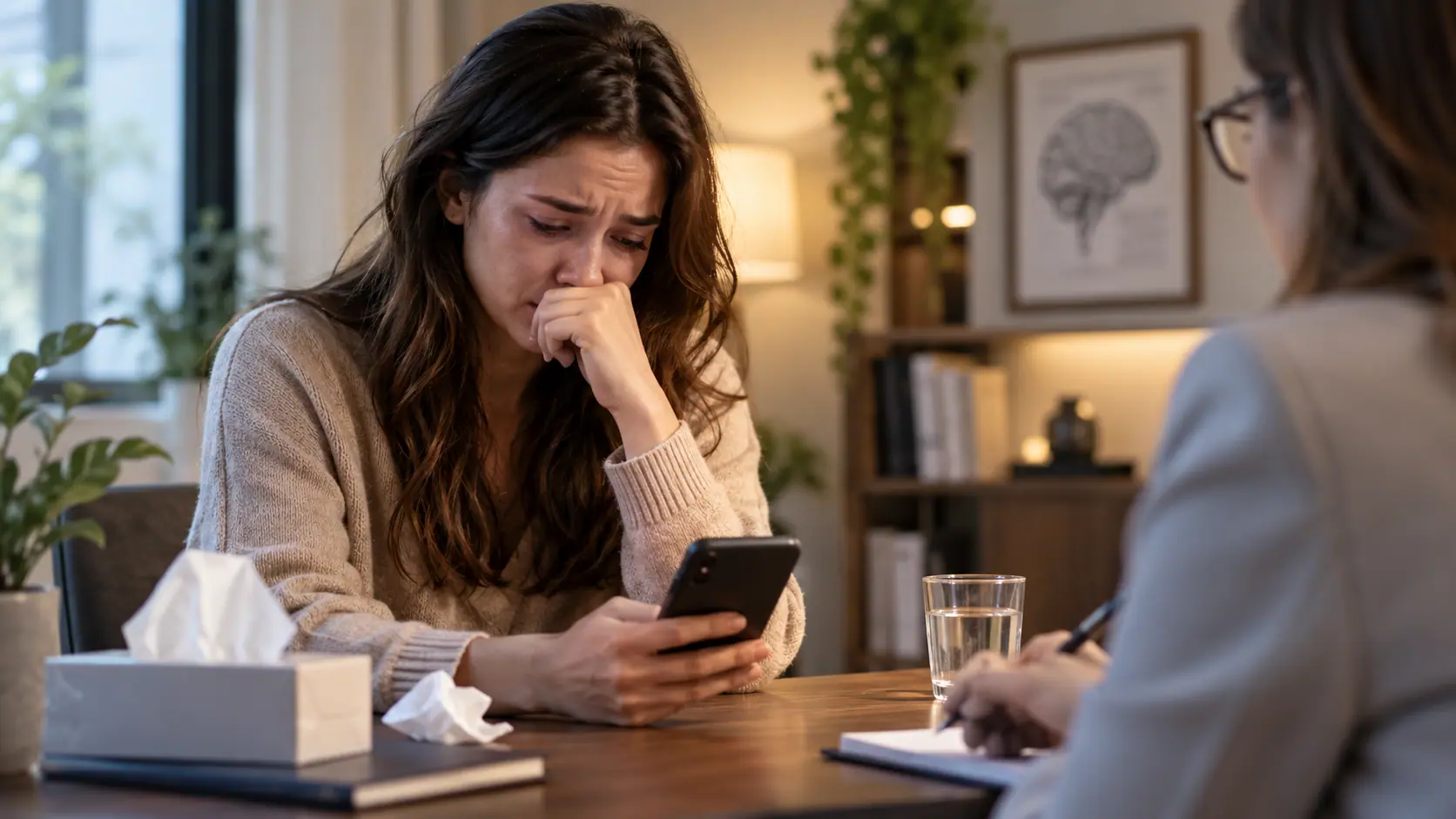
She has trouble sleeping. She avoids a meeting. Messages from strangers startle her. She does not know whether the looks she notices are a response to the video or to her own fear.
When she tries to explain, someone replies:
“But if it is not really you, why does it affect you so much?”
The fact that a scene is fake does not mean sharing it cannot cause harm. The AEPD specifically warns that generated or manipulated images can attribute nonexistent events to a person and affect relationships, reputation, and personal or professional functioning.
Supporting references: [1] AEPD · January 2026 guide.
However, recognizing that this harm can exist is one thing; establishing it in legal proceedings is another.
That requires distinguishing three questions:
What was shared? Who is responsible? What consequences has it had for the person affected?
No single professional answers all of them.
A fake image and real harm are different issues
These cases can involve different situations: an authentic photograph shared without permission, an unlawfully obtained recording, a manipulated image, or a threat to share one.
They should not be treated as identical.
A sexual deepfake is an image or video altered to depict someone in a nude or sexual situation. A qualitative study published in 2025 interviewed fifteen people affected and ten perpetrators of these behaviors in Australia. The findings describe varied experiences and consequences, as well as ways of minimizing what happened. Because of the study design, they cannot establish prevalence or predict how a particular person will react.
Supporting references: [2] PubMed · Qualitative study · 2025.
From the perspective of expert assessment, there is a fundamental distinction:
Proving that a file has been manipulated does not automatically measure the suffering it has caused. And demonstrating suffering does not authenticate the file or identify its creator.
Digital and clinical evidence can complement each other. They should not replace each other.
What psychological consequences have been studied?
Research links the nonconsensual sharing of intimate images to difficulties with health and well-being.
A study published in 2025, conducted with 3,150 US adults during the pandemic, found worse outcomes on various indicators of well-being among those who reported this experience. This is an association in a specific population and context, not proof of what happened in any given Spanish case.
Supporting references: [3] PubMed · Study in adults · 2025.
Another study from 2026, involving 803 young adults who reported traumatic experiences, examined the relationship between intimate image sharing, shame, and depressive symptoms. It found relevant associations, but does not establish the same causal mechanism in everyone.
Supporting references: [4] PubMed · Study in young adults · 2026.
These findings justify paying attention. They do not justify diagnosing in advance.
In an assessment, I would ask about sleep, anxiety, mood, relationships, intimacy, concentration, and activities the person has given up. I would also ask about abilities they retain and the help they have received.
The goal is not to assume the greatest possible severity. It is to describe the impact that can actually be supported.
Moral harm and psychological harm are not the same
This distinction can change the approach to a claim.
moral harm refers to the personal harm that may accompany a violation of rights. It is not limited to a psychiatric diagnosis.
psychological harm requires examining whether there is a clinical disturbance, its severity, course, treatment, and functional impact.
In the civil protection of honor, privacy, and one’s own image, Spain’s Organic Law 1/1982 establishes a presumption of harm when an unlawful intrusion is proven and provides for compensation for moral harm based on the circumstances, severity, and extent of dissemination. That legal rule does not amount to presuming that every affected person has a psychiatric disorder.
Supporting references: [5] BOE · Organic Law 1/1982.
A “more severe” diagnosis should therefore not be sought to make the harm seem significant.
Nor should it be concluded that no violation occurred if a disorder cannot be established.
These are related but different dimensions.
Related reading—a different context: Psychological violence and psychological harm.
Sending an image privately does not authorize sharing it
Article 197.7 of Spain’s Criminal Code covers certain situations involving the unauthorized sharing of intimate images obtained with the person’s consent when disclosure seriously infringes their privacy. It also regulates subsequent sharing by someone who has received them, under the conditions set out in the article.
Supporting references: [6] BOE · Criminal Code.
This does not mean that every conflict involving images automatically falls under that provision.
Files entirely fabricated using AI require their own legal analysis: a provision designed for images obtained in a real intimate context should not simply be applied to every fabrication.
Depending on the facts, data protection, privacy, honor, image rights, or other forms of liability may be involved. The AEPD explicitly distinguishes different avenues of liability, which must be examined case by case.
Supporting references: [7] AEPD · Frequently asked questions.
The lawyer examines legal classification and strategy. The psychiatrist does not decide which crime has been committed.
Before the report: seek protection, request removal, and preserve necessary information
There is no need to wait for an expert assessment before seeking help or trying to stop the sharing.
The AEPD has a Priority Channel for reporting sexual or violent content published online when its unlawful dissemination seriously endangers a person’s rights or health. The Agency reviews the request and may take urgent measures; this does not guarantee automatic removal of every copy.
Supporting references: [8] AEPD · Priority Channel.
To process a request, it asks for information about the circumstances, the web addresses or profiles sharing the material, and the steps already taken. Identifying where the content appears is more useful than simply saying that “it is everywhere.”
Supporting references: [9] AEPD · Information for a request.
There is an important limitation: according to the AEPD, this channel cannot intervene to remove content shared exclusively through instant messaging or email, without prejudice to other actions and potential liabilities. If it is circulating on WhatsApp or Telegram, that does not mean nothing can be done; it means the route to removal is different.
Supporting references: [10] AEPD · Limits of the Priority Channel.
INCIBE’s 017, a free, confidential service, can offer guidance on cybersecurity incidents and appropriate next steps.
Supporting references: [11] INCIBE · Helpline.
Preserving evidence should not increase exposure
I would coordinate with the lawyer or digital specialist to identify the information needed: addresses, profiles, dates, messages, threats, and records of takedown requests.
I would not ask the person to forward the images to relatives to “have witnesses” or publish them to prove that they are fake.
Nor would I advise uploading intimate material to unknown AI tools to check its authenticity. The AEPD guide warns of additional risks when providing images to these systems, such as loss of control, retention of copies, and other uses that are difficult to determine.
Supporting references: [1] AEPD · January 2026 guide.
If minors appear, the utmost caution is needed: do not download, reproduce, or forward sexual material to investigate it yourself. Seek instructions from the authorities or competent professionals and preserve devices without unnecessary handling.
What each professional contributes
| Question | Main professional role |
|---|---|
| Is the file manipulated? What technical information can be verified? | Digital or audiovisual expert assessment, depending on the issue and the resources available. |
| What legal avenues are available, and what needs to be proven? | Legal advice and representation. |
| Does psychological harm exist, how does it affect the person, and what link to the events can be supported? | Forensic psychiatric or psychological assessment, within each professional’s scope of practice. |
This division avoids asking an expert for a conclusion they cannot provide.
In my work, the purpose would not be to “prove that the video is fake” or “certify that someone is telling the truth.”
It would be to assess the clinical impact and explain the reasoning that does—or does not—support linking it to the events examined.
Digital evidence in another context—education and family: Bullying and cyberbullying.
How I would approach a forensic psychiatric assessment in these cases
A forensic assessment needs to integrate sources and consider their limitations. The American Academy of Psychiatry and the Law guideline highlights the importance of documentation, interviews, and collateral information, while recognizing that every source may have biases. It also requires explaining the purpose of the evaluation and the limits of confidentiality.
Supporting references: [12] AAPL · Forensic assessment guideline.
On that basis, I would organize this assignment around five questions.
1. What event are we assessing?
I would neither take every statement in a complaint as proven nor reduce the matter to “a photograph was shared.”
I would need to distinguish the person’s account from what is documented: publication, threats, known reach, repeated sharing, subsequent messages, or the material reaching the workplace.
I would also clarify whether the assessment concerns the current condition, a past impact, or possible lasting impairment.
2. When did the person learn what had happened?
The date a file was created or published may differ from the date the person learned about it.
Imagine an image circulating on day 1, but the affected person learning about it on day 12. That difference matters when interpreting the onset of insomnia.
That is why I would build a timeline connecting awareness of the events, symptoms, consultations, and the subsequent course, without filling gaps with assumptions.
3. What difficulties are present, and what abilities does the person retain?
I would not limit the assessment to an anxiety score.
I would explore what is happening, its intensity, and how it affects everyday life. I would also ask about times when the person functions better, available support, and activities they continue.
Retaining some abilities does not negate the harm. Nor should those abilities be concealed to make the situation seem more severe.
4. What other explanations need to be examined?
I would review the previous condition and concurrent events: a breakup, a work problem, an illness, substance use, or previous episodes.
The aim would not be to find a reason to discredit the person, but to avoid attributing everything that happens afterward to a single event.
5. What conclusion can be supported?
The report should explain whether there is enough information to establish psychiatric injury, which causal link is defensible, and what uncertainties remain.
It may conclude that there is a significant impact. It may also conclude that lasting impairment cannot yet be assessed, that several factors are involved, or that the available information is insufficient.
Independence does not begin when the report is signed. It begins with accepting that the conclusion has not been decided in advance.
In civil proceedings, Spain’s Civil Procedure Act requires expert witnesses to be objective, including considering what may favor or disadvantage either party.
Supporting references: [13] BOE · Civil Procedure Act.
“They already had anxiety”: why that information needs context
A previous history does not, by itself, answer the question of causation.
Consider two fictional examples.
One person had been stable for years, working and maintaining relationships. After learning that the images had been shared, they develop episodes of distress, insomnia, and a new limitation.
Another was already experiencing a severe episode before publication and also suffers a major loss during the same period.
It would not be appropriate to write the same explanation for both cases.
In the first, possible subsequent decompensation would need to be examined. In the second, the questions would be what additional change can be linked to the sharing and which aspects were already present.
I would not propose concealing previous history. I would propose describing it in a way that makes clear what actually changed.
Nor would I equate a short-lived post with a necessarily brief effect. In a particular case, concern may center on who received the file, not just how long it remained accessible. That hypothesis needs to be checked against the clinical course and known facts.
Not all harm after intimate image sharing is PTSD
Intense symptoms can occur without meeting the requirements for post-traumatic stress disorder.
PTSD requires assessment of the type of event, a specific set of symptoms, duration, and impact. Having nightmares or feeling very afraid is not enough to establish it.
Supporting references: [14] National Center for PTSD · Veterans Affairs.
In these cases, the assessment should determine whether those requirements are met or whether another diagnosis better describes the situation.
Not meeting PTSD criteria does not mean the suffering is fake or irrelevant.
Likewise, a diagnosis does not, by itself, establish who shared the file. It would be circular to claim that the events occurred because a disorder exists and that the disorder proves those events.
Clinical evidence must be integrated with documentary, digital, and witness evidence, without taking their place.
The difference between “she is very affected” and a useful expert description
A general statement conveys concern but leaves many questions unanswered.
In an assessment, I would try to turn it into specific information. For example, in a fictional scenario:
“Since learning that the images were shared, she has stopped attending certain meetings, sought care for insomnia, and needed someone to accompany her to work. It is necessary to examine what documentation supports these changes and how they evolve.”
This allows duration, intensity, and functioning to be examined.
It does not require inventing a suffering scale or exaggerating the diagnosis.
It also avoids a common error: confusing the number of views with clinical severity. In my analysis, I would examine reach alongside context, rather than treating it as an automatic multiplier of symptoms.
Sharing among people in the person’s own circle can have a different significance from anonymous exposure. The conclusion requires information from the case.
Treatment reports, expert assessments, and lasting impairment: three issues to distinguish
Treatment should begin when the person needs it, without waiting for a decision about a claim.
A treatment report can document consultations, symptoms, treatment, and progress. An expert assessment addresses a medical-legal question and must cross-check information, explain limitations, and remain independent. Clinical documentation is an important source for that assessment, but does not replace the entire analysis.
Supporting references: [12] AAPL · Forensic assessment guideline.
In addition, an early assessment does not require declaring permanent impairment.
If the condition is still evolving, I would offer a conclusion about the current state and identify what remains unresolved. I would not offer a definitive assessment simply because the proceedings need to move forward.
Receiving treatment and improving does not “ruin” the case. Expert work consists of honestly describing what happened and its course, not preserving symptoms to prove them.
Can compensation be claimed?
A claim for compensation may be possible, but a psychiatric report does not, by itself, determine either entitlement or the amount.
Organic Law 1/1982 provides for measures to stop and prevent unlawful intrusions and compensate for them. The legal assessment depends on the facts and the chosen legal avenue.
Supporting references: [5] BOE · Organic Law 1/1982.
In a case, I would propose separating the different elements: clinical impact, documented treatment expenses, potential financial losses, and moral harm. The lawyer must present them and avoid duplication.
An administrative penalty and compensation for the person affected are also different things. The AEPD distinguishes liability under data protection law from civil liability for damages.
Supporting references: [7] AEPD · Frequently asked questions.
I would not promise an amount or treat a diagnosis as though it carried a fixed price.
When an expert assessment is worth requesting
It can be useful when an impact needs documenting for legal proceedings, the causal link is disputed, or reports disagree.
Before commissioning a full opinion, I would propose clarifying with the lawyer which question it needs to answer and what documentation exists.
For that initial analysis, it would be enough to organize four groups of information: case documents, relevant clinical information, a brief timeline, and references to digital evidence already obtained lawfully.
It is not necessary to send intimate images through WhatsApp or ordinary email to explain the reason for seeking an appointment. Sensitive material should be handled through the agreed channel and only to the extent necessary.
The scope, time frame, and fees for an expert assessment depend on its complexity, the documentation, and the need for examinations, supplementary work, or court testimony.
Service information: Forensic psychiatry and psychiatric expert assessments.
The urgent need to feel safe should not have to wait for legal proceedings
If the situation causes suicidal thoughts, an intention to harm yourself, or an inability to stay safe, receiving care is the priority.
In immediate danger, call 112 or go to the emergency department. 024 offers free, confidential support available 24 hours a day for people with suicidal thoughts and their relatives; it does not replace necessary in-person care.
Supporting references: [15] Ministry of Health · Resources in Spain.
You do not need a complaint, a digital report, or a completed expert assessment to seek clinical help.
Do you need to document psychological harm after intimate image sharing?
If the sharing of photographs, videos, or fabricated images is affecting your health and there are legal proceedings or a potential claim, an initial assessment can help determine what can be assessed, what documentation is missing, and whether an expert report is appropriate.
Dr. Marc Agraz conducts independent psychiatric expert assessments of psychological harm, functional limitations, causal links, and lasting impairment, with in-person appointments in Lleida and online assessment when methodologically appropriate.
Service information: Forensic psychiatry and psychiatric expert assessments.
For individuals and lawyers, the first step is to define the purpose of the assignment, rather than anticipate a conclusion.
An expert assessment does not remove content, identify the responsible person on its own, or guarantee compensation. It provides an independent clinical assessment that must be integrated with the rest of the evidence.
General information. This does not replace legal advice, an individual assessment, or urgent care. The initial administrative contact does not require sending intimate images.
Frequently asked questions
Can psychological harm occur even if the image was created with AI?
Yes, it can. The fact that the scene did not happen does not prevent its attribution and sharing from affecting the person. The existence and extent of harm must be assessed individually, not presumed from the type of file.
Supporting references: [1] AEPD · January 2026 guide.
Can a psychiatrist prove that the video is fake?
Not simply by being a psychiatrist. Authenticity analysis requires specific expertise and techniques. My role would focus on the clinical impact and its relationship to the documented facts.
Is seeking an assessment worthwhile if the post has already been removed?
It can be. Removal and clinical condition are different questions. The assessment would need to examine which symptoms remain and how they have evolved, without assuming either immediate recovery or inevitable lasting impairment.
Do I need a PTSD diagnosis for the harm to be significant?
No. The diagnosis should reflect the findings, rather than be chosen for its apparent weight in a claim. Moral harm and psychiatric injury are not equivalent concepts either.
Can the expert assessment be conducted online?
That depends on complexity, security, and examination needs. Online assessment is used only when appropriate for the assignment; in-person assessment may be recommended.
Service information: Forensic psychiatry and psychiatric expert assessments.
Sources and resources
References cited in the manuscript on intimate image sharing, protection, clinical impact, and expert assessment. Digital evidence, legal classification, and psychological harm are examined on different levels; associations in studies do not resolve an individual case.
Third-party images in AI systems: visible and invisible risks
Guide cited on sexualization, attribution of false events, personal consequences, and loss of control when providing images to artificial intelligence tools.
View referenceExperiences and consequences of sexual deepfakes
Research cited involving interviews with fifteen people affected and ten perpetrators of these behaviors in Australia. Its design cannot establish prevalence or predict an individual reaction.
View referenceNonconsensual sharing and well-being during the pandemic
Study provided involving 3,150 US adults during the pandemic. The article retains the associative nature of its findings and the limits of extrapolating them to a particular case.
View referenceIntimate image sharing, shame, and depressive symptoms
Study cited involving 803 young adults who reported traumatic experiences. The associations described do not establish the same causal mechanism in everyone.
View referenceMoral harm, privacy, image rights, and compensation
Law cited on civil protection, unlawful intrusions, and assessment of moral harm. Its presumption of harm does not amount to presuming a psychiatric disorder.
View referenceUnauthorized sharing of intimate images
Article 197.7 cited in the manuscript. Its application to the facts and the analysis of fabricated files require legal assessment; the clinical report does not classify the crime.
View referenceLiability for the unlawful sharing of sensitive content
Resource cited to distinguish avenues of liability and differentiate administrative penalties from compensation for damages to the affected person.
View referenceRequest intervention concerning sexual or violent content online
Channel cited for reporting particularly serious unlawful sharing. The article does not promise automatic removal or deletion of every copy.
View referenceCircumstances, addresses, and steps to identify
Guidance cited on the information needed to report sharing: circumstances, web addresses or profiles, and steps taken.
View referenceInstant messaging, email, and other courses of action
The cited source defines the limits of the channel’s intervention in sharing through messaging or email, without excluding other actions and liabilities.
View reference017: cybersecurity guidance
Service cited for free, confidential guidance on cybersecurity incidents and appropriate next steps.
View referenceDocumentation, collateral sources, and confidentiality
Guideline cited on forensic assessment, collateral information, source biases, and explaining the assignment and its limits of confidentiality. It does not replace the legal framework applicable to the case.
View referenceExpert objectivity and consideration of both parties
Law cited on the duty of objectivity, taking into account what may favor or disadvantage either party.
View referenceDiagnostic requirements for post-traumatic stress disorder
Resource cited to distinguish intense symptoms from a PTSD diagnosis, considering the event, symptoms, duration, and impact.
View referenceThe 024 line and urgent care
Information cited on support for people with suicidal thoughts and their relatives, and the priority of emergency care when there is immediate danger.
View referenceGeneral information. This does not replace legal advice, an individual assessment, or urgent care. The initial administrative contact does not require sending intimate images.


