


🎮💳 Behavioral addictions
· Video games · Loot boxes · Microtransactions · Childhood and adolescence
Free video games, real costs
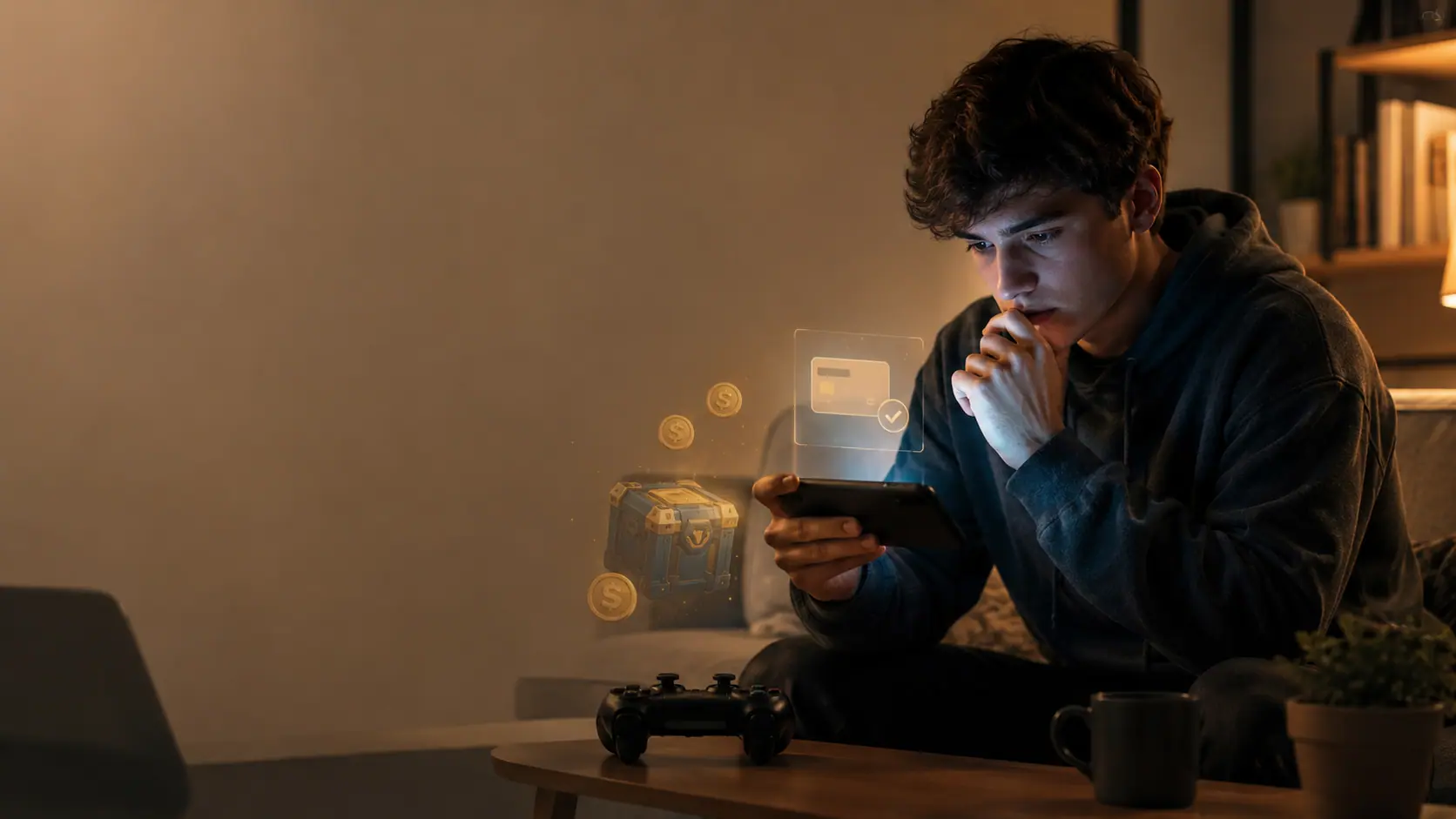
When card packs, loot boxes, gacha, and microtransactions stop being part of recreation and start controlling the player’s money, sleep, routine, and decisions.
The video game was free
At first, there was no charge to download it, create an account, or start playing. Then the first purchase cost 1.99 euros. Then a limited-time offer appeared for 4.99: a season pass, a special character, virtual currency, and a pack that might contain the player everyone wanted.
Finally, at the end of August, the family reviews the bank account and finds dozens of small charges: five euros, ten, twenty, and another five. The teenager insists:
“I didn’t spend that much. They were only small purchases.”
Yet when added up, the total exceeds several hundred euros. When the parents remove the card or restrict purchases, irritability, distress, threats, desperation, or the conviction that everything achieved in the game will be lost may appear.
The question that changes the case
Then a question arises that we hear more and more often:
Are they hooked on the video game, or on buying things within the video game?
Indeed, these are not always the same. Someone may play for many hours without spending, spend impulsively without meeting gaming disorder criteria, get caught up in loot boxes without ever having gambled, or have gaming, spending, and gambling problems at the same time. That is why, before using the word
addiction, it is worth understanding what is happening.
In one minute: the problem is not measured only in hours or euros.
- First, the WHO recognizes gaming disorder when there is impaired control, increasing priority, and continuation despite harm, with significant functional impairment.
- Furthermore, in Spain, 84.4% of students ages 14 to 18 play video games; the 2025 screening estimated possible addiction in 8.6% of boys and 1.8% of girls.
- A study of 2,308 Austrian students also found that the top-spending 10% accounted for 61.4% of all spending.
- Specifically, high spenders had spent between 400 and 12,000 euros in one year and showed more indicators of gaming disorder and problem gambling.
- A loot box is also not like every other purchase: you pay without knowing exactly what reward will appear.
- Indeed, serious financial harm may occur before all the criteria for a disorder are met.
- Finally, blocking payment may be necessary, but alone it neither explains nor treats the loss of control.
Key sections of this article
2 Microtransactions
3 Loot boxes and chance
4 Not just dopamine
5 Virtual money
6 The free-to-play model
7 Four different problems
8 Spanish data
9 A bridge to gambling
10 Back to routine
11 Twelve warning signs
12 What to do at home
13 Treatment
14 Online therapy
15 Frequently asked questions
1) The new finding: 10% generate most of the spending
In August 2026, a study was published involving 2,308 Austrian students ages 10 to 19. Of these, 818 had made in-game purchases during the previous year.
61.4% of spending
Specifically, the top-spending 10% accounted for almost two-thirds of all recorded purchases.
400–12,000 euros
High spenders had also spent very large amounts during the previous twelve months.
It did not depend on family wealth
Socioeconomic status, by contrast, did not significantly explain who ended up spending more.
More problematic indicators
Possible gaming disorder also appeared in 14.1% of high spenders, compared with 4.2% of occasional purchasers.
This finding therefore challenges the idea that heavy spenders can simply afford it. A teenager may use allowance money, gifts, savings, family cards, money obtained without permission, or payments so fragmented that no one has yet calculated the true total.
High spending was also associated with more symptoms of gaming disorder and problem gambling. However, the cross-sectional design cannot establish which comes first: spending may intensify a pattern of impaired control, but those who are already more vulnerable may also end up spending more.
The association is concerning; causation still needs more research.
2) What microtransactions really are
In simple terms, a microtransaction is a purchase made within a video game. For example, it may buy an appearance, a character, an upgrade, virtual currency, an expansion, time, energy, competitive advantages, or a random reward. However, they do not all carry the same risk.
Direct purchase
Here, the player knows what item they will receive and how much it costs. Impulsive spending may occur, but chance is not necessarily involved.
Paying to progress
This, by contrast, allows faster progress, avoids waiting, or provides a competitive advantage that does not depend solely on skill.
Season pass
Payment is also made for rewards that must be unlocked within a time limit, which may encourage continued play to avoid “wasting” the purchase.
Loot box or card pack
Here, payment is made without knowing the exact contents. A common item, a rare one, or the desired reward may appear.
Gacha
For example, this is a random-pull system, common in certain mobile games, for obtaining characters or items of varying rarity.
Rotating store
Finally, these are offers available only briefly, creating urgency through fear of missing a supposedly unique opportunity.
Buying a known item is not the same as paying for the chance to obtain it.
3) Why loot boxes resemble gambling
First, not every loot box legally meets the definition of gambling. Even so, many share psychological and structural elements with gambling: there is payment, an uncertain outcome, prizes of unequal value, rapid repetition, and a desired item that may never appear.
Mechanisms that encourage continued spending
- For example, near misses: the feeling of having come close increases the desire to repeat.
- Also, the illusion of control: an animation, a streak, or a promotion is interpreted as a sign that the outcome can be predicted.
- Another is sunk cost: the more has been spent, the harder it seems to stop without obtaining the reward.
- Also, high frequency: each opening leads within seconds to another opportunity.
- By contrast, unpredictable rewards: uncertainty maintains anticipation.
- Finally, artificial scarcity: limited events and items turn waiting into a supposed loss.
The thinking that maintains the cycle
“I’ve opened so many packs; it has to come soon.”
“I can’t stop after everything I’ve invested.”
“I only need one last pull.”
“If I don’t get it today, it will disappear.”
However, each opening may be independent of the previous ones. Spending a hundred euros does not oblige the system to deliver the desired item with the next purchase.
4) It is not simply “dopamine”
On social media, almost any addictive behavior is often explained by saying it “releases dopamine.” That explanation is insufficient. Dopamine is involved in learning, motivation, anticipation, and reward, but impaired control over microtransactions also depends on age, impulsivity, peer pressure, competitiveness, attachment to the character, urgency of offers, immediate access to payment, and emotional state.
What a virtual reward can represent
Prestige
For example, displaying a rare item may convey status within the group.
Belonging
Owning certain characters or appearances also helps players feel part of the community.
Identity
The avatar and its collection may also form part of how the player presents themselves to others.
Advantage
Finally, paying may allow better competition or help avoid feeling left behind.
That is why saying “just stop buying” may be as insufficient as telling someone with problem gambling to “just stop gambling.” Payment serves a function within an emotional and social ecosystem.
5) Virtual money makes spending feel less real
First, many games do not display prices directly in euros. Gems, credits, points, tokens, coins, or bundles are purchased first; that currency is then exchanged for items. Buying 1,200 gems therefore does not feel the same as paying 14.99 euros.
Designs that reduce friction
- bundles in amounts that are hard to convert into euros;
- leftover currency that encourages another purchase;
- limited-time offers and countdown clocks;
- discounts available for only a few hours;
- pop-ups and commercial notifications;
- rewards for logging in every day;
- and one-click payments.
Consequently, these features are not always decorative: they may form part of an architecture that prolongs engagement and encourages spending. This does not mean every video game is predatory. It means the product should be evaluated rather than placing responsibility solely on the player.
6) “It’s free”: the model that needs someone to spend heavily
Economically, free-to-play video games earn revenue through advertising, in-game purchases, or both. Most players may spend little or nothing; however, the business may depend on a small group spending far larger amounts.
The industry has also historically used the term “whales”
for these high spenders. The language is revealing: the person stops being viewed as a player and is valued instead according to how much money can be extracted from them.
The Austrian study also found a concentration of spending similar to that observed in gambling markets. However, microtransactions and gambling for money remain distinct phenomena and must not become interchangeable diagnoses.
The problem is not that a company makes a profit, but that a disproportionate share comes from users with impaired control or particular vulnerability.
7) Intensive use, problematic spending, addiction, and gambling disorder are not synonyms
Intensive use
For example, someone plays for many hours, especially on vacation, but retains control, fulfills responsibilities, and recreation does not cause major impairment.
Problematic use
Disrupted sleep, arguments, lateness, isolation, excessive spending, or difficulty respecting limits appear, even if all diagnostic criteria are not yet met.
Gaming disorder
Here, there is impaired control, increasing priority, and continuation despite negative consequences, with significant impairment and usually a sustained pattern.
Microtransaction problem
Here, loss of control centers on purchasing: spending more than intended, hiding payments, using credit or someone else’s money, and being unable to stop.
Gambling disorder
Specifically, this involves wagering money or other things of value under uncertainty. It may coexist with problematic gaming, but is a different clinical question.
Combined problems
Finally, some people simultaneously experience excessive gaming, compulsive buying, gambling, ADHD, anxiety, depression, or severe sleep disturbance.
A good assessment identifies which problem exists rather than assuming they are all the same.
8) What the Spanish data show
In Spain, the official 2025 report on behavioral addictions, based on a representative sample of more than 35,000 students, shows that video games are a regular part of adolescent recreation: they are used by 84.4 % of young people ages 14 to 18.
8.6 %
Specifically, this is the estimate of possible addiction among boys.
1.8 %
By contrast, this is the equivalent estimate among girls.
4,916
These were also the recorded treatment admissions for behavioral addictions in 2023.
However, these percentages come from screening instruments and do not mean all these adolescents received a clinical diagnosis. Moreover, 81% of treatment admissions involved gambling, while around 9% jointly involved video games, social media, and other digital devices.
We are therefore not facing an epidemic in which every teenager who plays is ill. But neither is the problem imaginary.
9) Can loot boxes bring players closer to gambling?
Research suggests a relationship, although it should be explained without alarmism. For example, a Spanish study of 6,633 adolescents and young adults found more indicators of possible gaming disorder and online gambling problems among those who had bought loot boxes. However, it was cross-sectional: it shows association, not causation.
Another longitudinal study followed 561 Flemish adolescents for one year. Initial engagement with loot boxes, prize wheels, social casinos, and other gambling-like elements subsequently predicted more gambling behavior, indirectly through attitudes and intention.
Even so, that design does not eliminate all alternative factors either. Impulsivity, family rules, advertising exposure, friends, ADHD, sensation-seeking, and access to money may influence both behaviors.
Gambling-like mechanics may normalize chance and spending in vulnerable people, but they do not automatically turn every player into someone who will develop gambling disorder.
10) September: when returning to routine reveals the problem
First, playing more during summer may seem normal: schedules are looser, there is no school, friends stay connected, and many events last several weeks. Some families also relax limits while working or trying to balance responsibilities.
Then September brings a reality check. It is time to turn off the console, go to bed earlier, leave a game in progress, return to studying, and pass up an offer that ends that very night.
What may become visible
- intense and prolonged irritability;
- a completely reversed sleep schedule;
- refusal to attend school;
- inability to study;
- isolation and abandonment of activities;
- lies or hidden accounts;
- unauthorized purchases;
- and disproportionate anxiety when access is limited.
September does not necessarily cause addiction; it may reveal a pattern that vacation kept hidden.
11) Twelve warning signs
Ultimately, no single sign confirms a disorder. However, the pattern, persistence, and impairment justify an assessment when several appear.
1. They cannot stop
Each game leads to another despite an agreement to finish.
2. Gaming dominates the day
Meals, sleep, studies, and relationships are organized around being online.
3. Intense irritability
Limits trigger anxiety, aggression, or loss of control that continues afterward.
4. Sleep has changed
They play in the early hours, sleep during the day, or get up to complete events.
5. Hidden purchases
They delete emails, use cards without permission, or minimize their spending.
6. Repeated small charges
They do not recognize the monthly total because each payment seems insignificant.
7. They chase a reward
They keep buying because they feel the prize “must be just about to appear.”
8. They pay to avoid falling behind
They fear losing competitiveness, status, or belonging within the group.
9. Attempts to cut back fail
The promises are sincere, but last only a few days.
10. Performance declines
Homework, studies, work, or self-care are pushed aside.
11. It replaces almost all recreation
Going out, exercising, and maintaining relationships lose their appeal.
12. It helps them avoid feelings
Gaming or purchasing regulates anxiety, sadness, loneliness, anger, or emptiness.
12) “My child gets angry when I take the game away”: does that prove addiction?
Not necessarily. For example, any teenager may protest when an enjoyable activity is interrupted, especially when playing with friends and unable to leave a cooperative game immediately.
However, intensity, duration, and context make the difference. There is more reason for concern when anger continues long afterward, violence or threats occur, no alternative is tolerated, they lie to regain access, use devices in the early hours, steal money, or sleep, studies, and relationships are already impaired.
The assessment should not focus solely on the reaction to switching off the console; it should examine the child’s entire life.
13) It is not only an adolescent problem
Adults can also lose control in sports games, mobile titles, persistent worlds, strategy games, digital card games, social casinos, or character collections.
Indeed, someone may maintain employment and responsibilities while spending hundreds of euros a month, hiding it from their partner, using credit, playing during work, sleeping little, or living around completing events.
“I don’t have a problem because I work and can afford it.”
However, financial means are not the only criterion. Control, concealment, interference, distress, and actual freedom to stop also matter.
14) ADHD, anxiety, depression, and other vulnerabilities
Impaired control over video games and microtransactions may also coexist with other problems. A complete assessment therefore does not ask only how many hours the person plays.
ADHD
Novelty, impulsivity, difficulty waiting, and poor organization may encourage rapid or repeated purchases.
Social anxiety
The online world offers more predictable relationships and less exposure to uncomfortable situations.
Depression
Gaming provides structure, reward, and competence when the rest of life seems dull.
Autism
An intense interest or a valued community does not automatically mean addiction; control and harm matter.
Bullying or loneliness
The online group may become the only place where the teenager feels a sense of belonging.
Family conflict
The video game may serve as a refuge from difficult dynamics at home.
The clinical question is not just “how many hours do they play?” but “what do they find inside the game that they are not finding outside it?”
15) The mistake of humiliation
By contrast, phrases such as “you’re an addict,” “you’ve become useless,” or “video games are destroying you” tend to increase defensiveness, secrecy, damage to the relationship, and resistance to seeking help.
The person should therefore not be reduced to a label. A diagnosis can guide treatment, but does not sum up who they are or erase their abilities, interests, or possibility of recovery.
Taking responsibility for lies, spending, or harm is necessary. Humiliation is not treatment.
16) What families can do today
Review actual spending
Check purchase histories, statements, cards, platforms, subscriptions, and virtual currency. The first goal is to understand the scale.
Remove automatic payments
Removing saved cards, requiring a password, and disabling one-click purchases reduce impulsivity and stop immediate harm.
Convert everything to euros
Writing down what each bundle costs restores clarity to an economy hidden behind gems or credits.
Disable promotions
Notifications, temporary events, and personalized offers may act as triggers.
Protect sleep
Phones, consoles, and computers should not control the early hours or remain in the bedroom without clear limits.
Agree on specific rules
Define when, for how long, after which responsibilities, how much money, and what consequences will follow if the rules are not met.
Do not secretly cover the spending
Replacing money or repeatedly paying debts without a plan may allow the pattern to continue.
Restore other rewards
Sports, music, friendships, in-person projects, and recreation that does not depend on video games.
Finally, when every limit ends in war, the family may already need outside support. Seeking help does not mean demonizing gaming: it means restoring communication, financial safety, and functioning.
17) Should video games be banned completely?
Sometimes access must be temporarily removed, especially with fraudulent spending, financial risk, violence, severely disrupted sleep, or repeated breaches of agreements. However, an abrupt ban does not always solve the problem.
For example, it may increase conflict, encourage hidden accounts, shift use to other devices, or replace the behavior with another compulsion. The therapeutic goal is therefore not always to live without video games.
More useful goals
- regaining control over starting and stopping;
- restoring sleep and schedules;
- fulfilling responsibilities;
- restoring financial transparency;
- maintaining relationships and physical activity;
- and enjoying other sources of reward again.
In severe cases, temporary abstinence may form part of the plan, although it should have a defined clinical purpose and be accompanied by alternatives.
18) What is happening with Spanish regulation?
Spain currently has the Draft Organic Law for the Protection of Minors in Digital Environmentsunder consideration. Its initial text includes measures targeting certain random reward mechanisms.
However, as of August 31, 2026, the initiative remains with the Justice Committee at the report stage. It should therefore not be presented as a fully effective ban. Nor does it necessarily affect every in-game purchase: the focus is on systems combining payment, chance, and virtual rewards under certain conditions.
Ultimately, regulation can reduce exposure, but does not replace financial education, purchase controls, responsible design, family supervision, or access to treatment. Nor should an entire industry be demonized: the problem is concentrated in certain combinations of design, vulnerability, and impaired control.
19) How gaming addiction or microtransaction problems are treated
First, treatment begins by distinguishing the problem. Intervention may be needed for gaming time, spending, loot boxes, gambling, sleep, impulsivity, anxiety, depression, ADHD, family relationships, or several factors simultaneously.
Psychological interventions
Specifically, cognitive behavioral therapies are the most studied interventions. For example, they may address triggers, justifying thoughts, stimulus control, emotion regulation, relapse prevention, and rebuilding routines.
Mapping the pattern
Which game, when, with whom, how much is spent, and what emotion precedes the behavior.
Stimulus control
Payments, devices, schedules, notifications, rotating stores, and high-risk contexts.
Emotion regulation
Learning to tolerate boredom, frustration, anxiety, loneliness, and the need for reward.
Relapse prevention
Preparing for events, new releases, vacations, limited-time offers, and a return to demanding routines.
Family intervention
Reducing power struggles, agreeing on limits, and avoiding both humiliation and financial permissiveness.
Co-occurring conditions
Treating ADHD, depression, anxiety, insomnia, bullying, isolation, or relationship problems when present.
Family interventions also appear particularly useful for minors, although research remains heterogeneous. There is also no “pill to quit video games.” Medication may be appropriate for a properly diagnosed co-occurring condition, but does not replace behavioral and family work.
20) Can online therapy help?
In many cases, yes. Video consultations may also provide an entry point when the patient feels ashamed, lives far away, studies or works, the family needs guidance, or frequent follow-up is needed without an emergency.
What an assessment can distinguish
- intensive use without a disorder;
- problematic use;
- gaming disorder;
- loss of control over purchases;
- gambling or gambling disorder;
- and combinations with ADHD, anxiety, depression, or insomnia.
Specifically, Dr. Marc Agraz’s practice assesses digital habits, interference with sleep, studies, work, and relationships, financial functioning, psychiatric co-occurring conditions, and family needs.
However, in-person or urgent care may be required with severe violence, suicide risk, psychosis, several days without sleep, complete school nonattendance, major financial fraud, or an inability to ensure safety.
21) Signs of crisis
Sometimes restricting spending, removing a device, or losing an account can trigger a very intense emotional reaction. Urgent help should be sought if there are:
- threats of suicide or self-harm;
- violent destruction of objects;
- assaults or running away;
- significant disorganization;
- several days without sleep;
- or loss of contact with reality.
In immediate danger, call 112 or go to an emergency department.
The national 024 line is also free, confidential, and available 24 hours a day for people with suicidal thoughts or suicide risk and their families. It does not replace in-person care in an emergency.
22) My clinical position
Most do not have an addiction
We should not turn a common and socially important pastime into an illness by default.
Hours alone are not enough
Impaired control, the priority given to gaming, and impairment matter more.
Spending adds information
A serious financial problem may exist even when gaming time does not seem extreme.
Not every purchase carries the same risk
A known direct purchase is not the same as a rapid, repeatable random reward.
Design matters
Not everything can be explained as a lack of individual willpower.
Regulation is not enough
Families and professionals will still need educational and clinical tools.
Recovery is broad
Sleep, studies, relationships, physical activity, emotions, and financial transparency are part of treatment.
This is not about declaring war
It is about recognizing when an entertainment product exploits vulnerabilities and reduces the ability to choose.
23) Conclusion: when free becomes too expensive
The video game may have been downloaded without payment. Yet the bill may arrive later: in money, sleep, arguments, lies, isolation, performance, and freedom.
First, a single purchase does not demonstrate a problem. Likewise, protesting when a game ends or playing many hours on vacation does not automatically mean illness. But if the person cannot stop, hides their spending, chases random rewards, neglects their life, and continues despite harm, this is no longer merely entertainment.
The decisive indicator is not how much they enjoy playing, but how much control they retain when trying to stop playing or stop paying.
September may therefore be a good time to restore schedules, review spending, and talk without accusations. When the family no longer knows how, seeking help is not an overreaction: it is intervening before the cost becomes greater.
24) Regaining control without demonizing video games
Does your child spend money on card packs, loot boxes, skins, or virtual currency and hide how much they pay? Do they become intensely angry when gaming or purchases are restricted? Do you yourself feel you have lost control over video games, gacha, or microtransactions?
An early assessment can distinguish recreation, impulsive spending, gaming disorder, and problem gambling, and develop a plan tailored to the person and their family.
A responsible assessment does not aim to remove all video games.
It aims to restore control, functioning, and freedom.
Related reading: problematic screen use and impaired control.
If money is also at stake: video games, chance, and online gambling.
When impulsivity and executive difficulties are present: ADHD, reward, and differential diagnosis.
Frequently asked questions
Loot boxes, purchases, and diagnosis
What is a loot box?
Specifically, it is a box, card pack, or virtual reward with random contents. The player may pay to open it without knowing exactly which item they will receive.
Are loot boxes gambling?
Indeed, they share elements with gambling, such as payment, uncertainty, and variable rewards. However, not all necessarily meet the legal definition of a wager, and regulation depends on their specific characteristics.
Does buying skins mean having an addiction?
No. For example, an occasional, transparent, controlled purchase does not imply a disorder. The problem appears with impaired control, excessive spending, concealment, or major consequences.
How can I tell whether my child is addicted to video games?
First, the main signs are inability to control gaming, increasing priority over other activities, and continuation despite academic, family, social, or physical impairment.
How many adolescents show possible gaming addiction in Spain?
In Spain, the official 2025 report estimated possible addiction in 8.6% of boys and 1.8% of girls ages 14 to 18. These are population screening results, not individual clinical diagnoses.
Why can small payments add up to such a large amount?
This happens because they are made quickly, repeated over weeks, and may use virtual currencies that make the accumulated cost in euros harder to recognize.
What does chasing a reward mean?
Specifically, it means continuing to pay because the person believes the desired item must appear soon, or that they have already invested too much to stop.
Can loot boxes bring players closer to gambling?
Some studies find associations and longitudinal findings compatible with a possible normalization of gambling. However, not every player progresses to gambling, and personal, family, and social factors also contribute.
Family, treatment, and emergencies
Should I take the console away completely?
It depends on severity. Temporarily blocking purchases or access may be necessary, but a ban alone does not treat the causes of impaired control. It should be accompanied by a family and clinical plan.
What should I do if they used my card without permission?
First, immediately protect payment methods, review the entire history, preserve documentation, and discuss the problem without violence. If there is repetition, deception, or impaired control, seek a professional assessment.
Does online therapy work for gaming addiction?
In many cases, it can help assess the pattern and address limits, craving, sleep, spending, and co-occurring conditions, while also guiding the family. Serious-risk cases may require in-person intervention.
Is there medication to quit video games?
Currently, there is no specific medication approved for gaming disorder. Medication may be used for particular co-occurring conditions, but the main treatment is usually psychological, behavioral, and family-based.
When should I seek urgent help?
Finally, when there are thoughts of suicide, self-harm, severe violence, psychosis, several days without sleep, complete school nonattendance, or an inability to ensure safety.
Sources and further reading
These sources allow readers to review the clinical definition of gaming disorder, spending data, the situation in Spain, the possible bridge to gambling, regulation, and treatment evidence.
Diagnosis and spending data
Definition of gaming disorder
Impaired control, increasing priority, continuation despite harm, and significant functional impairment.
High spenders in digital gaming
Study of 2,308 students on spending concentration, microtransactions, and symptoms of gaming and gambling disorders.
Report on behavioral addictions
National data on video games, possible addiction, internet use, gambling for money, and treatment admissions.
Video games, gambling, regulation, and treatment
From gambling-like elements to gambling for money
Longitudinal adolescent study on loot boxes, social casinos, attitudes, and intention to gamble.
Protection of minors in digital environments
Official record and parliamentary status of the draft organic law under consideration.
Treatment of gaming disorder
Synthesis of controlled trials on symptoms, gaming time, anxiety, depression, and psychological interventions.
Clinical notice and limitations of this publication
Note: this publication is educational and does not replace an individual psychiatric, psychological, family, educational, or legal assessment.
With violence, suicide risk, self-harm, psychosis, several days without sleep, or immediate danger, call 112 or go to an emergency department. The 024 line offers support related to suicidal behavior.
Do not stop treatments, confront the situation with violence, or interpret a number of hours or an amount spent as a diagnosis without assessing control, impairment, context, and co-occurring conditions.


